

Part ofClaude vs Everything: The Complete Claude Comparison
Gemini CLI vs Claude Code: Google's free open-source agent against Anthropic's paid depth. Models, tooling, costs and the honest verdict.
In This Article
9 sectionsClaude Code wins the Gemini CLI vs Claude Code matchup on code quality, agentic depth, and autonomy — it finished Composio's full-build test 45 minutes faster with fewer retries. Gemini CLI won on price, with 1,000 free requests a day, until Google retired its individual tier on June 18, 2026 in favor of Antigravity CLI.
That last clause outweighs any benchmark. We've run both agents on this site's codebase since Gemini CLI shipped, and for a year the honest answer was "the free one, until it isn't enough." Google just ended the free part. Here's what changes.
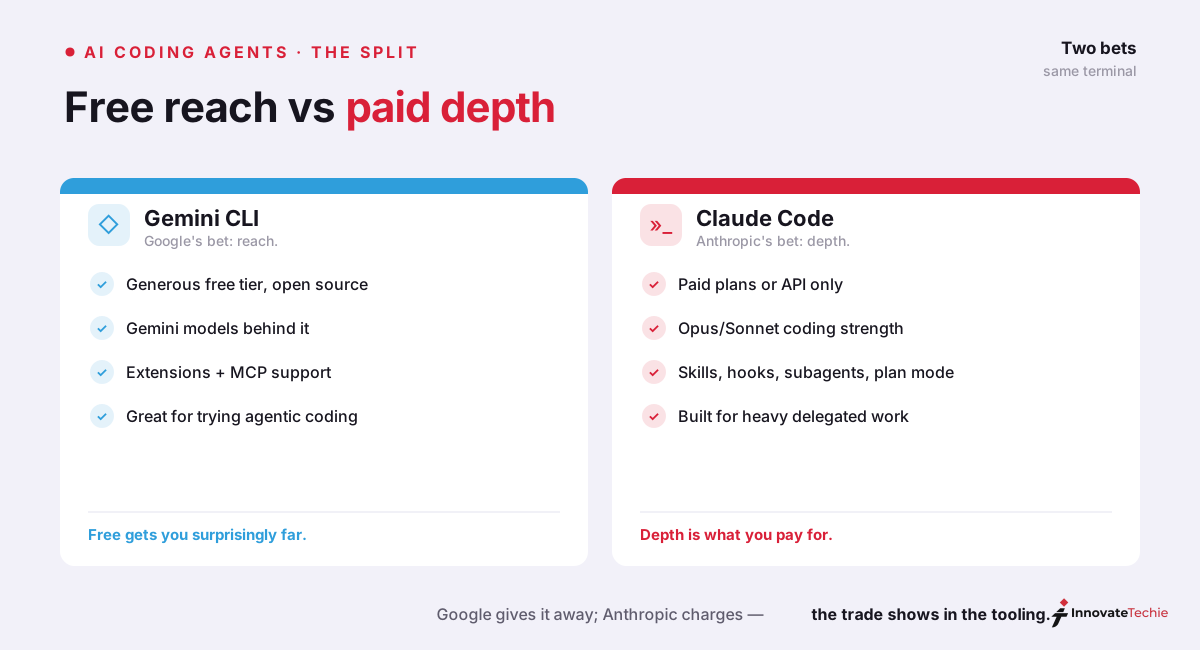
Two philosophies: reach versus depth
The split starts with the business models. Google shipped Gemini CLI in June 2025 as an open-source agent under an Apache 2.0 license: sign in with a personal Google account, pay nothing, get Google Search grounding and MCP support in your terminal. The bet was reach — free and everywhere, so developers default to it.
Anthropic's Claude Code made the opposite bet. It has cost money from day one — a Claude Pro plan at minimum, or API credits — and spends that money on depth: plan mode that proposes before editing, a permission system, an extension stack of skills, hooks, subagents, and plugins. Our pillar guide What Is Claude Code? covers the foundations; this piece sits in our wider AI comparisons hub.
That asymmetry is why most claude code vs gemini cli threads were really pricing threads. One tool asked for $20 a month, the other for a Google login. Every other difference had to justify that gap.
Gemini CLI vs Claude Code: head-to-head comparison
Here's the scorecard on the dimensions that decide real work:
| Gemini CLI | Claude Code | |
|---|---|---|
| License | Open source, Apache 2.0 | Proprietary |
| Models | Gemini 3 Pro, Gemini 3 Flash | Claude Opus 4.8, Sonnet 5, Haiku 4.5 |
| Context window | 1M tokens from launch | 1M tokens, GA since March 2026 |
| Free tier | Was 1,000 requests/day at 60/min | None — paid plan or API required |
| Entry price | $0 with a Google account (pre-retirement) | Claude Pro, $20/month |
| Extensibility | Extensions, MCP, custom commands, Agent Skills | Skills, plugins, hooks, subagents, MCP |
| Autonomy | Needs nudging on long tasks | Plan → approve → execute, long unaided runs |
| Code quality reputation | Fine for scripts and scaffolds | Cleaner, more idiomatic multi-file work |
| Status | Individual tier retired June 18, 2026 → Antigravity CLI | Actively developed |
Two rows carry most of the weight — pricing and status — so let's take them in order.
Pricing: the most generous free tier the terminal ever saw
Pricing is where the fight was most lopsided. Gemini CLI's free tier set a bar nobody else touched: 60 requests per minute and 1,000 requests per day on a personal Google account, no credit card attached. Three caveats piled up over time:
- Model downgrades. Free sessions quietly fell back to Flash under load — and from late March 2026, Google limited free users to Gemini 3 Flash outright and moved Gemini 3 Pro behind paid plans.
- Quality followed the model. Flash is quick and fine for scaffolds; it is not the model that made the benchmark headlines.
- The tier had an expiry date nobody saw coming. June 18, 2026.
Claude Code never pretended to be free — it isn't. You need a Claude Pro plan at $20/month, a Claude Max plan at $100 (5x usage) or $200 (20x), or per-token API billing: Claude Sonnet 5 at an introductory $2/$10 per million tokens until August 31, 2026 (then $3/$15), Claude Opus 4.8 at $5/$25, Claude Haiku 4.5 at $1/$5.
| Cost line | Gemini CLI | Claude Code |
|---|---|---|
| Free tier | 1,000 requests/day, 60/min (ended June 18, 2026) | None |
| Entry | $0 with a personal Google account | Claude Pro, $20/month |
| Power tier | Google AI Pro / Ultra for higher limits | Claude Max, $100 or $200/month |
| API rates | Gemini 3 Flash around $0.50/$3 per MTok | Sonnet 5 $2/$10 intro; Opus 4.8 $5/$25; Haiku 4.5 $1/$5 |
| Model access at entry | Flash-only for free users since late March 2026 | Full lineup from Pro up |
The honest math from our own usage: Gemini's free tier covered roughly 80% of routine terminal asks — explain this error, scaffold this component, write this one-off script. Claude Code earned its subscription on the other 20%: multi-hour refactors and production diffs, where a retry loop costs more than a month of Pro.
The Antigravity twist: Google ended the free lunch
At Google I/O 2026, Google announced Antigravity CLI as Gemini CLI's successor, and the official transition notice set a hard date: on June 18, 2026, Gemini CLI stopped serving individual-tier requests — free accounts, Google AI Pro, and Ultra alike. Organizations on Gemini Code Assist Standard or Enterprise licenses keep access unchanged.
The details sting for the community that built it. Gemini CLI had merged over 6,000 community pull requests under Apache 2.0; Antigravity CLI is a closed-source Go rewrite without full feature parity at launch, though it keeps Agent Skills, hooks, subagents, and extensions (rebranded as plugins). Google Gemini CLI, Claude Code's loudest free rival, is now enterprise-only — and that rewrote the Gemini CLI vs Claude Code calculus in one stroke. The free pillar of every "why pay Anthropic?" argument just fell away for individuals.
Models and context: the 1M-token race ended in a tie
For most of the Gemini CLI vs Claude Code rivalry, context was Google's trump card. Gemini CLI shipped with a 1-million-token window — whole-repo reads on day one — while Claude Code worked within 200K. That gap closed in March 2026, when Anthropic made the 1M context window generally available at standard per-token pricing, with paid Claude Code plans getting the full window automatically. Our Claude context window guide covers how to use it without drowning the model.
On models, the matchup is Gemini 3 Pro and Gemini 3 Flash against Claude Opus 4.8, Claude Sonnet 5, and Claude Haiku 4.5. Claude Opus 4.8 leads the hardest public coding benchmark, SWE-bench Pro, at 69.2%; Sonnet 5 lands at 63.2% for less than half the price (Claude Sonnet vs Opus covers when each earns it). The pattern in every gemini vs claude coding comparison we trust matches ours: Gemini models are quick on isolated tasks, Claude models stronger at long-horizon, multi-file engineering.
Agentic depth: the same nouns, different maturity
Here's the part most gemini cli comparison posts get wrong: on paper, both agents speak the same extension vocabulary. In practice, the depth differs sharply.
| Layer | Claude Code | Gemini CLI |
|---|---|---|
| Reusable instructions | Skills — SKILL.md folders | Agent Skills — same open standard |
| Tool connectivity | MCP servers | MCP servers |
| Packaged bundles | Plugins via marketplaces | Extensions: MCP + context + commands |
| Lifecycle automation | Hooks on every agent event | Hooks, added later and simpler |
| Parallel work | Subagents and agent teams | Subagents, basic orchestration |
| Scope control | Plan mode before execution | Confirm-per-action prompts |
The tell is portability: Claude Code skills follow the open Agent Skills standard, which Gemini CLI adopted — one SKILL.md folder loads in both agents unmodified. But Claude Code's stack goes deeper where autonomy is decided: plan mode locks scope before execution, hooks gate every lifecycle event, subagents coordinate as teams with shared task lists. Gemini CLI's extensions solved distribution well, and Google's successor kept all four concepts. When your competitor's roadmap keeps shipping your nouns, you're the reference design.
Speed and code quality: what a 10-million-token test showed
The most-cited Gemini CLI vs Claude Code experiment is Composio's build test: one identical prompt — a Python CLI agent wired to local and managed MCP servers — given to both tools, roughly 10 million tokens burned across the runs. Three numbers decide it:
- Claude Code finished in 1 hour 17 minutes; Gemini CLI took 2 hours 2 minutes, and needed manual nudging plus retries to get there.
- Claude Code's run cost $4.80; Gemini CLI's fragmented attempts cost $7.06. The "expensive" tool was cheaper where it counted.
- Structure quality followed the same order. Claude's output came back cleaner and better organized; Gemini's was decent but less polished.
That matches our experience. Gemini CLI feels faster per interaction — Flash responses snap back — but Claude Code is faster per outcome, because it wanders less. Published comparisons agree: Claude Code writes more idiomatic code and survives multi-file refactors with fewer errors, while Gemini CLI is perfectly serviceable for isolated scripts and exploration.
Verdict: who should pick which
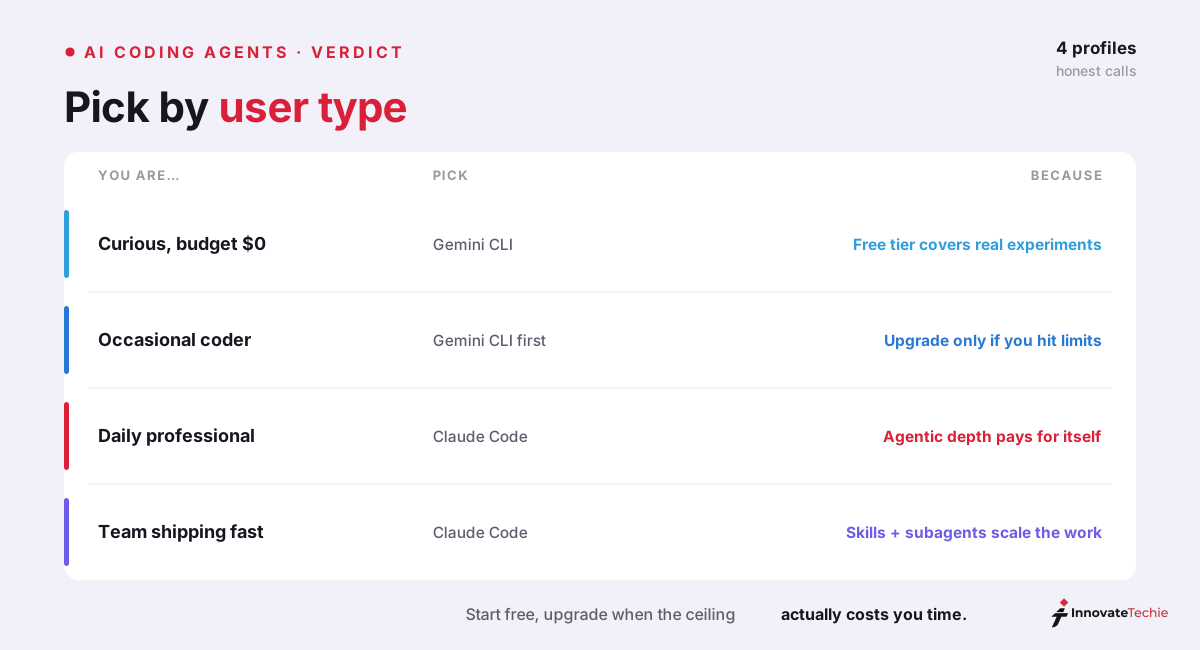
The Gemini CLI vs Claude Code verdict, compressed by user type:
| Your situation | Pick | Because |
|---|---|---|
| Production codebase, multi-file refactors | Claude Code | Opus 4.8's 69.2% SWE-bench Pro lead plus the cleaner-output reputation |
| Quick scripts, scaffolds, learning to code | Gemini CLI was the pick — now Antigravity CLI | The free tier covered this completely |
| Long autonomous runs you walk away from | Claude Code | Finished Composio's build unaided; Gemini needed nudges |
| Enterprise with Gemini Code Assist seats | Gemini CLI | Access, support, and current models continue unchanged |
| Whole-repo context reads on a $0 budget | Gemini CLI, historically | 1M tokens free was unbeatable; Claude's 1M needs a paid plan |
| One agent for everything, cost secondary | Claude Code | Deepest extension stack: skills, hooks, subagents, plan mode |
The popular hybrid — free Gemini CLI for exploration and big-context reads, Claude Code for the work that ships — is now a migration question, since individual Gemini CLI access ended in June 2026. If you're re-evaluating the field, our Codex vs Claude Code and Cursor vs Claude Code breakdowns cover the other two serious contenders.
For example, a solo developer trying agentic coding for the first time loses nothing starting on Gemini CLI — and knows within a week whether the depth ceiling matters.
Claude pricing at a glance
| Plan | Price |
|---|---|
| Free | $0 |
| Pro | $20 / month |
| Max | from $100 / month |
| API | Pay per token |
For the full breakdown of every plan, see our how much Claude costs guide.
Frequently Asked Questions

Written by
InnovateTechie
Writing about Claude and the Anthropic toolkit — models, Claude Code, pricing, features, and fixes, in clear, practical, hands-on guides tested by daily use.
View all posts →