

Part ofWhat Is Claude Code? The Complete Guide
Codex vs Claude Code: delegation in OpenAI's cloud versus collaboration in your terminal. Benchmarks, costs and which agent fits you.
In This Article
8 sectionsClaude Code writes cleaner code and handles repo-wide refactors better; Codex is faster, cheaper per task, and built for hands-off delegation. In blind reviews, Claude Code's output wins 67% of the time — yet 65% of surveyed developers prefer Codex daily. Pick by workflow: collaboration means Claude Code, background delegation means Codex. That's the Codex vs Claude Code trade in one paragraph. The rest of this piece is the evidence behind it — and where our own experience disagrees with the crowd.
Delegation or collaboration: two opposite bets
OpenAI Codex and Anthropic's Claude Code look like the same product from a distance — describe a goal, get working code — but they're built on opposite bets about how developers want to work.
Codex bets on delegation. In its flagship cloud mode, you write a task spec, OpenAI clones your repository into a managed cloud container, and a GPT-5.5 agent works there in the background — running tests, iterating on failures, and coming back with a pull request for you to review. You can tag @codex on a GitHub issue and walk away. There's also Codex CLI, an open-source local agent for the terminal (which is why "codex cli vs claude code" has become its own debate), but the cloud background-and-review workflow is the product's center of gravity.
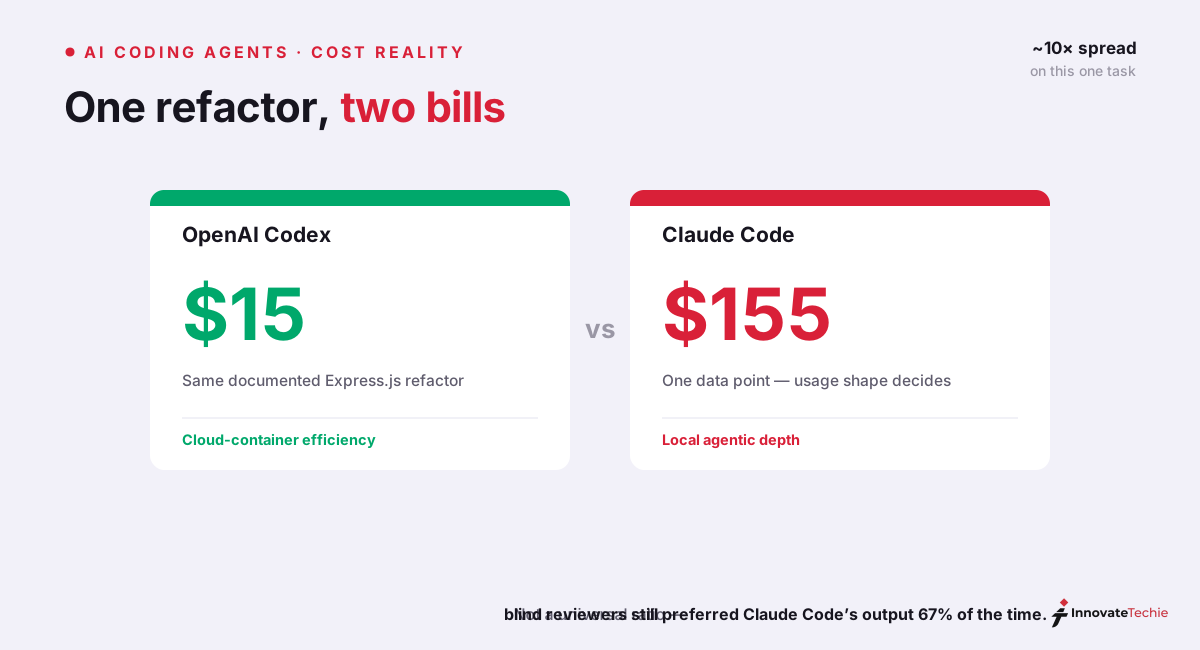
Consider the documented Express refactor again: $15 versus $155 for the same diff — usage shape, not quality, drove the gap.
Claude Code bets on collaboration. It runs in your real environment — terminal, VS Code, JetBrains, desktop app, or browser — reads your actual codebase, and works a plan-approve-execute loop: propose an approach in plan mode, get your sign-off, then edit files and run your own test suite with your own tools. Skills, plugins, MCP servers, hooks, and subagents extend it in every direction. If you're new to the tool, start with our full guide to what Claude Code is.
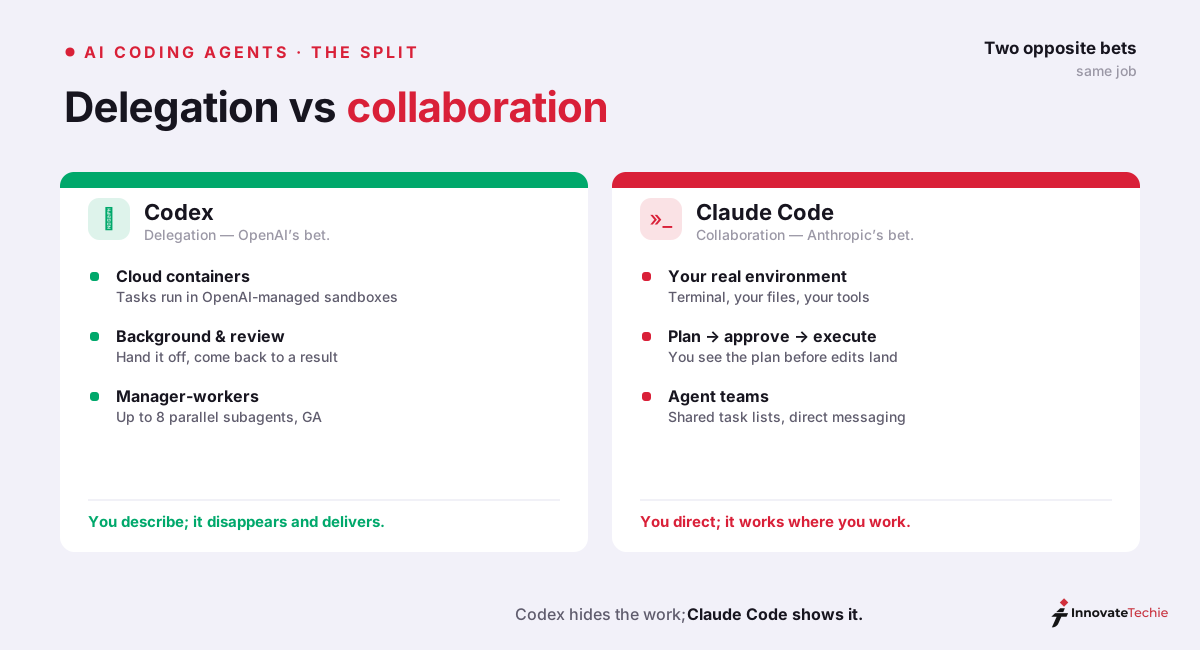
Most Codex vs Claude Code arguments are really this philosophy argument in disguise. If you want to fire off five tickets before lunch and review the pull requests after, Codex's model fits you. If you want an agent pair-programming inside your repo — your conventions, your git history, your environment — Claude Code fits you. We use both daily, and the tool we reach for is decided by the task shape far more often than by any benchmark.
Codex vs Claude Code: head-to-head comparison
Here's the OpenAI Codex vs Claude Code matchup on the dimensions that actually change your week:
| OpenAI Codex | Claude Code | |
|---|---|---|
| Philosophy | Delegate to the cloud, review the PR | Collaborate locally: plan → approve → execute |
| Model | GPT-5.5 | Claude Opus 4.8 / Sonnet 5 / Haiku 4.5 |
| Where it runs | OpenAI-managed cloud containers, plus a local CLI, IDE extension, and ChatGPT apps | Your machine: terminal, VS Code, JetBrains, desktop app, web |
| SWE-bench Pro | 58.6% | 69.2% |
| Terminal-Bench 2.0 | 82.7% | 69.4% |
| Blind code review | Rated cleaner in 25% of cases | Rated cleaner in 67% of cases (8% tied) |
| Multi-agent | Manager-worker: up to 8 parallel cloud workers | Agent teams: subagents with shared task lists and messaging |
| Extensibility | AGENTS.md instructions, GitHub integration | Skills, plugins, MCP servers, hooks, subagents, plan mode |
| Entry price | ChatGPT Plus, $20/month | Claude Pro, $20/month |
| Power tier | ChatGPT Pro, $200/month | Claude Max, $100–200/month |
| Token appetite | Roughly 4× fewer tokens per task | Reads more, verifies more, burns more |
No sweep in either direction — which is exactly why the "which one wins" framing needs the next two sections.
What the benchmarks actually say
The benchmark picture splits cleanly in two, and pretending one side runs the table is how people end up with the wrong tool. Four numbers matter as of July 2026:
- Claude Opus 4.8 leads SWE-bench Pro: 69.2% versus 58.6% for GPT-5.5. SWE-bench Pro is the hardest public repo-scale benchmark — long-horizon, multi-file fixes in real codebases — and a 10.6-point gap there is not noise.
- GPT-5.5 leads Terminal-Bench 2.0: 82.7% versus 69.4%. Shell workflows, environment setup, ops-flavored tasks: genuinely Codex's home turf.
- SWE-bench Verified is a coin flip. GPT-5.5 leads by 0.1 point, which any honest reader calls a tie.
- Blind code review is not a coin flip. When reviewers rated output without knowing which agent wrote it, Claude Code's code was judged cleaner and more idiomatic 67% of the time, Codex's 25%, with 8% tied.
We weight that fourth number heaviest, and here's the reason: benchmarks score "did the tests pass," while the blind review scores "would a senior engineer approve this diff." Code that passes today but needs rewriting next quarter is not a win — it's deferred cost. The Codex vs Claude Code benchmark story, compressed: Codex completes terminal tasks faster; Claude Code leaves behind code your team will actually keep.
The cost reality: usage shape decides
Every Codex vs Claude Code cost thread eventually lands on the same discovery — the subscription prices match, and the real costs don't.
One documented, widely circulated data point makes it concrete: the same Express.js refactor cost about $15 on Codex and about $155 on Claude Code at API rates. That tenfold gap isn't a pricing-table difference. It's a behavior difference: Claude Code reads more context, verifies more aggressively, and burns roughly 4× the tokens for equivalent work. On a gnarly refactor, that thoroughness is exactly what you're paying for. On a well-specified ticket, it's expensive redundancy.
| Cost line | Codex | Claude Code |
|---|---|---|
| Entry subscription | ChatGPT Plus $20/mo — rarely hits limits in a workday | Claude Pro $20/mo — heavy sessions can hit caps in hours |
| Power tier | ChatGPT Pro $200/mo | Claude Max $100–200/mo |
| Documented refactor (API rates) | ~$15 | ~$155 |
| Token efficiency | ~4× fewer tokens per task | Higher burn, deeper verification |
| Cheapest lever | Already the cheap option | Run Sonnet 5 ($2/$10 per MTok intro until Aug 31, 2026) instead of Opus 4.8 ($5/$25) |
On subscriptions, the same shape shows up as limits rather than invoices. The forum consensus matches our experience: Codex on ChatGPT Plus runs most of a workday on $20, while Claude Code on Claude Pro can exhaust a heavy Opus session in hours. Power users of either tool land in the $100–200/month range regardless of logo.
Two levers narrow the gap on the Claude side. First, default to Sonnet and escalate to Opus 4.8 only when its SWE-bench Pro lead actually matters — our Claude Sonnet vs Opus breakdown covers exactly when the cheaper model is safely enough. Second, use plan mode to lock scope before execution; most runaway token bills we've seen came from letting the agent wander unsupervised.
Subagents: manager-workers versus agent teams
The Codex vs Claude Code contrast extends to multi-agent work: both tools parallelize, but the architectures mirror the philosophy split. Codex uses a manager-worker pattern: an orchestrator splits your job and runs up to 8 workers in parallel cloud containers — delegation, scaled. Claude Code ships agent teams: subagents with shared task lists and inter-agent messaging, coordinating inside your environment — collaboration, scaled. Our take after running both: Codex's parallelism is better for clearing many independent tickets at once; Claude Code's teams are better at dividing one hard problem without the pieces drifting apart.
Codex or Claude Code: which should you pick?
Here's the Codex vs Claude Code decision compressed into a table. Find your row, and be honest about it:
| Your situation | Pick | Because |
|---|---|---|
| Large codebase, repo-wide refactors | Claude Code | SWE-bench Pro lead (69.2%) plus the 67% blind-review quality edge |
| Well-specified tickets you can hand off | Codex | Background containers and a review-the-PR workflow built for delegation |
| Strict policies on proprietary code | Claude Code | Runs locally; only the conversation goes to the API — no repo clone in someone else's cloud |
| All-day usage on a $20 budget | Codex | ~4× token efficiency; Plus limits rarely bite |
| Terminal-heavy ops and scripting | Codex | Terminal-Bench 2.0 lead, 82.7% vs 69.4% |
| Code quality and team conventions above all | Claude Code | The blind-review margin compounds with every merged diff |
| Non-coder shipping small tools | Codex | Delegate-and-review asks less supervision than iterate-and-approve |
Running both: what most of us actually do
By mid-2026, the smartest answer to Codex vs Claude Code is usually "both." Two subscriptions cost $40/month — less than half of either power tier — and the tools slot into different halves of the day. The pattern we've settled into, and the one we see most on engineering teams:
- Codex as the default workhorse: boilerplate, well-specified tickets, terminal chores, a background queue of PRs that you review over coffee.
- Claude Code for the surgical work: repo-wide refactors, unfamiliar-codebase archaeology, gnarly debugging — anywhere the quality edge repays the token burn.
If your shortlist also includes IDE-first tools, our Cursor vs Claude Code comparison covers that third philosophy. And if you're really choosing between the assistants behind these agents, start one level up with Is Claude better than ChatGPT?
Claude pricing at a glance
| Plan | Price |
|---|---|
| Free | $0 |
| Pro | $20 / month |
| Max | from $100 / month |
| API | Pay per token |
For the full breakdown of every plan, see our how much Claude costs guide.
Frequently Asked Questions

Written by
InnovateTechie
Writing about Claude and the Anthropic toolkit — models, Claude Code, pricing, features, and fixes, in clear, practical, hands-on guides tested by daily use.
View all posts →