

Part ofClaude vs Everything: The Complete Claude Comparison
Claude wins on writing quality, coding, and long documents; ChatGPT wins on images, voice, and versatility. Here's the task-by-task breakdown to pick yours.
In This Article
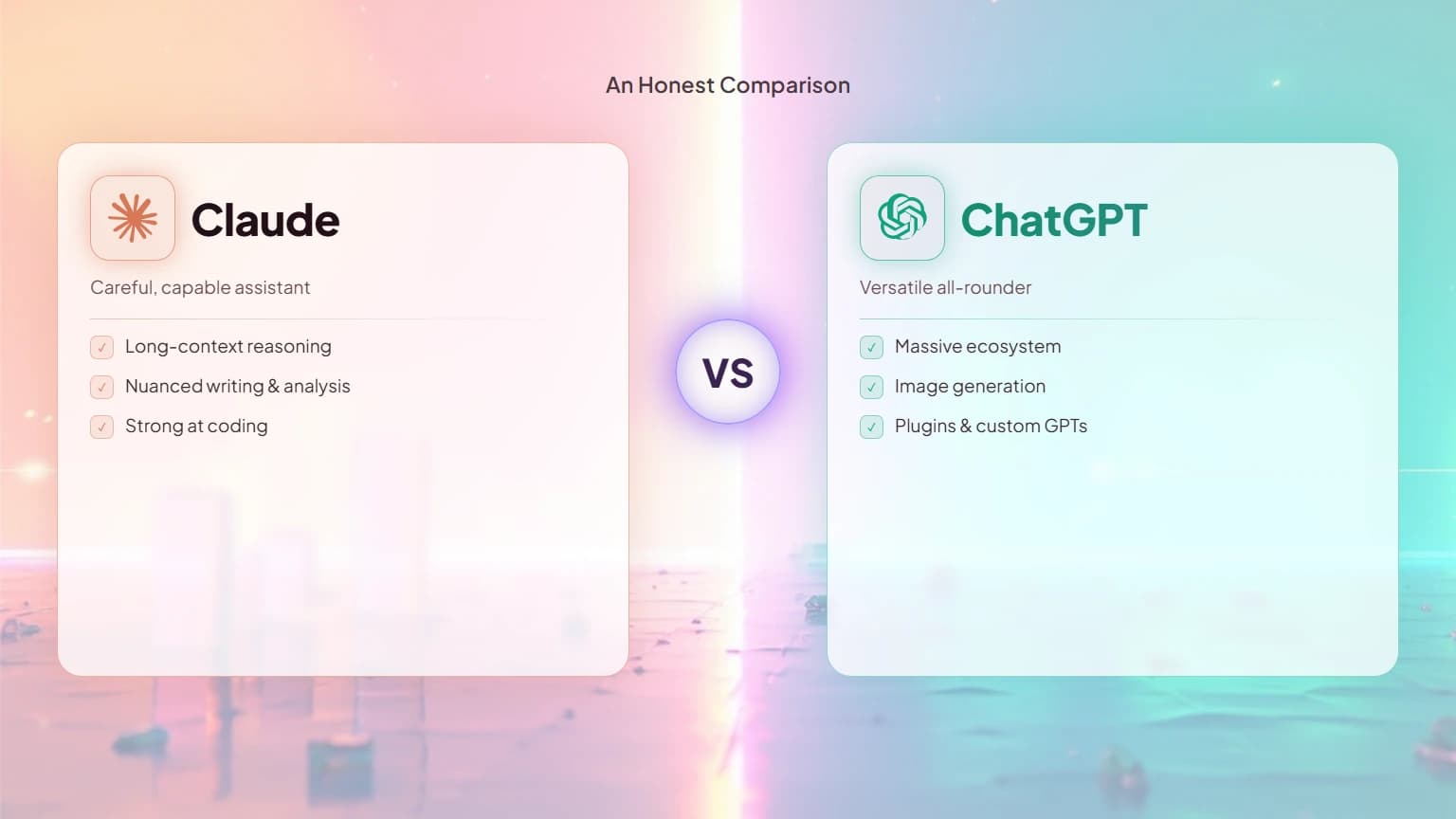
8 sectionsSo, is Claude better than ChatGPT? For writing, coding, and working through long documents — yes; ChatGPT is better for image generation, voice, and all-round versatility. Neither is "better" at everything — the right pick depends on what fills your day. Below is the task-by-task breakdown, with pricing and a simple decision rule.
This guide is part of our wider Claude comparison hub, where we stack Claude against every major rival.
Claude vs ChatGPT: the one-minute comparison
Both assistants sit on frontier models, cost $20/month at the standard paid tier, and handle text, files, images-in, code, and web search. The differences that actually change your results live one level down.
| Claude (Anthropic) | ChatGPT (OpenAI) | |
|---|---|---|
| Current flagship models | Sonnet 5, Opus 4.8 | GPT-5 series |
| Standard paid plan | Pro — $20/month | Plus — $20/month |
| Top-end plan | Max — $100–$200/month | Pro — $200/month |
| Context window | Up to 1M tokens | Smaller in the chat app |
| Image generation | No | Yes — built in |
| Voice conversations | Limited | Yes — mature voice mode |
| Agentic work | Claude Code, Cowork, computer use | Operator-style agents, custom GPTs |
| Signature strength | Prose quality, coding, long context | Versatility, multimodal, ecosystem |
For example, feed both the same 300-page contract: Claude holds it in one window while ChatGPT's chat context taps out far earlier.
Where Claude is better than ChatGPT
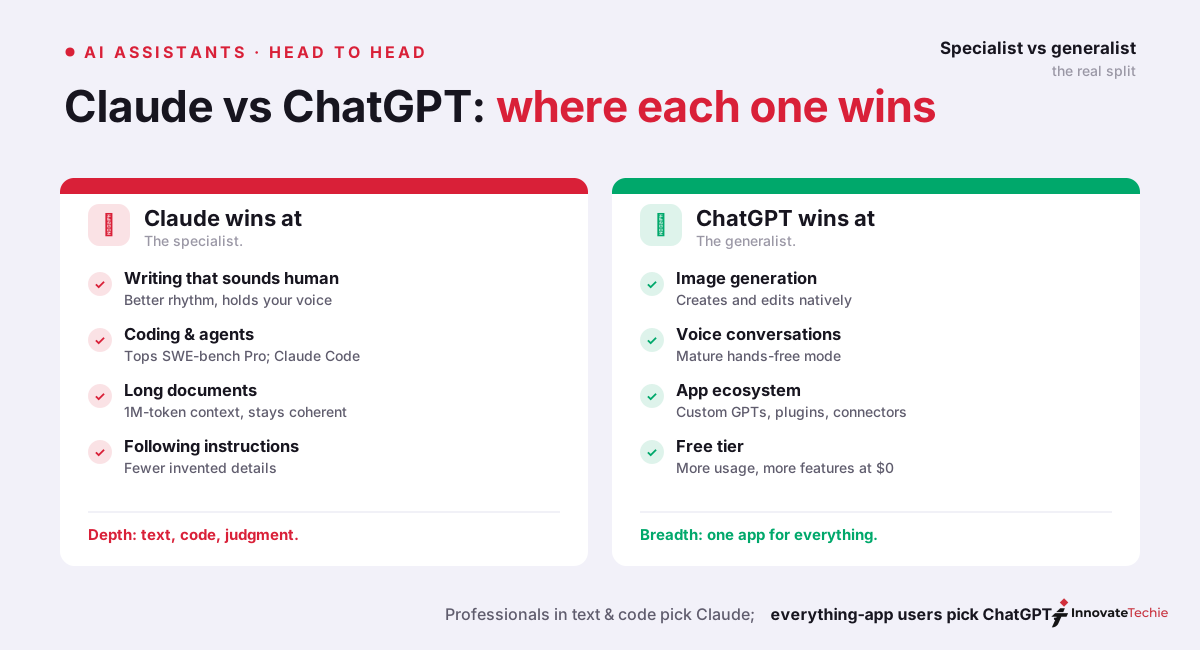
Writing that doesn't sound like AI. This is the most common reason people switch. Claude's prose is noticeably more natural — better rhythm, less filler, fewer of the tell-tale "delve/tapestry/testament" patterns. For emails, essays, marketing copy, and fiction, Claude's drafts typically need fewer editing passes. It's also better at holding a voice: give it three paragraphs of your writing and it will actually stay in that register.
Long documents. Claude's 1M-token context window swallows entire codebases, book manuscripts, or a folder of contracts in one conversation — and, crucially, stays coherent deep into that context. If your work is "read this 300-page thing and answer questions," Claude is the tool. ChatGPT's chat app context is far smaller, and quality degrades faster as it fills.
Coding — especially agentic coding. Claude's models have led real-world coding benchmarks for most of the past two years (Opus 4.8 currently tops SWE-bench Pro at 69.2%), but the bigger advantage is Claude Code — the terminal agent that plans, edits multiple files, runs your tests, and iterates until they pass. OpenAI's Codex CLI competes, but developer mindshare and tooling depth are firmly on Claude's side. If you're choosing which Claude model to code with, see our Sonnet vs Opus breakdown.
Instruction-following and judgment. Claude is more careful about doing exactly what you asked — respecting format constraints, admitting uncertainty instead of confidently inventing details, and pushing back when your request has a flaw. For work where a fabricated citation or a silently ignored constraint costs you real time, that reliability compounds.
Delegating whole tasks. Claude Cowork extends the agent model beyond code: point it at your files and it drafts the report, builds the spreadsheet, or organizes the folder — finishing a task, not just answering a prompt.
Where ChatGPT is better than Claude
Image generation. ChatGPT creates and edits images natively; Claude doesn't generate images at all. If visuals are part of your workflow, this alone decides it.
Voice. ChatGPT's voice mode is mature enough to use hands-free daily — brainstorming on a walk, language practice, quick questions while cooking. Claude has nothing comparable yet.
The everything-app ecosystem. Custom GPTs, a huge plugin/app surface, connectors to consumer services, and the largest user community for shared prompts and workflows. ChatGPT is a Swiss-army knife; whatever niche thing you want, someone has probably built a GPT for it.
Free tier generosity. Both offer free tiers, but ChatGPT's is more usable day-to-day: higher message allowances, more features included (including limited image generation). Claude's free tier runs on Sonnet with tight caps — fine for evaluation, cramped for daily use.
Breadth of memory and personalization. ChatGPT's cross-chat memory has had longer to mature, and its personalization (custom instructions + memory + connected apps) is deeper out of the box. Claude's memory is newer and more conservative.
What about benchmarks?
The honest answer for 2026: the benchmark gap between frontier models is narrow, and it flips with every release cycle. Claude leads on real-world software-engineering suites like SWE-bench Pro; GPT-5-class models post excellent scores on math and multimodal reasoning. Both are far past "good enough" for everyday tasks.
That's why this comparison focuses on workflow fit instead of leaderboard decimals. A 2-point benchmark edge won't change your output. Whether your assistant can hold a 400-page document, generate an image, run your test suite, or speak out loud — that changes your output.
Pricing: effectively a tie, until it isn't
At the standard tier, price is a wash: $20/month either way (Claude Pro vs ChatGPT Plus). The differences appear at the edges:
- Free: ChatGPT's free tier does more. If you'll never pay, ChatGPT is the better default.
- Heavy use: Claude Max at $100/month (5× Pro limits) undercuts ChatGPT Pro at $200/month for professionals who mainly need more of the same model rather than exclusive features. Max at $200/month (20× limits) matches ChatGPT Pro's price with dramatically higher usage headroom for agentic coding.
- API: for developers, Claude Sonnet at $3/$15 per million tokens is aggressively priced for its capability class — full breakdown in our Sonnet vs Opus pricing math.
So, is Claude better than ChatGPT? The verdict by use case
| Your main task | Better choice | Why |
|---|---|---|
| Writing & editing | Claude | More natural prose, better voice control |
| Coding | Claude | Model quality + Claude Code agent |
| Long-document analysis | Claude | 1M context, stays coherent |
| Image generation | ChatGPT | Claude can't |
| Voice assistant | ChatGPT | Mature voice mode |
| Research with citations | Tie | Both search the web; verify either |
| Automating office tasks | Claude | Cowork finishes whole tasks |
| General life admin | ChatGPT | Versatility + ecosystem + free tier |
The pattern behind the table: Claude is a specialist's tool that rewards depth — ChatGPT is a generalist's tool that rewards breadth. Professionals whose output is text or code overwhelmingly land on Claude. People who want one assistant for everything land on ChatGPT.
And plenty of power users simply pay for both — $40/month for the best of each is cheap compared to the time either one saves.
How to decide in 30 seconds
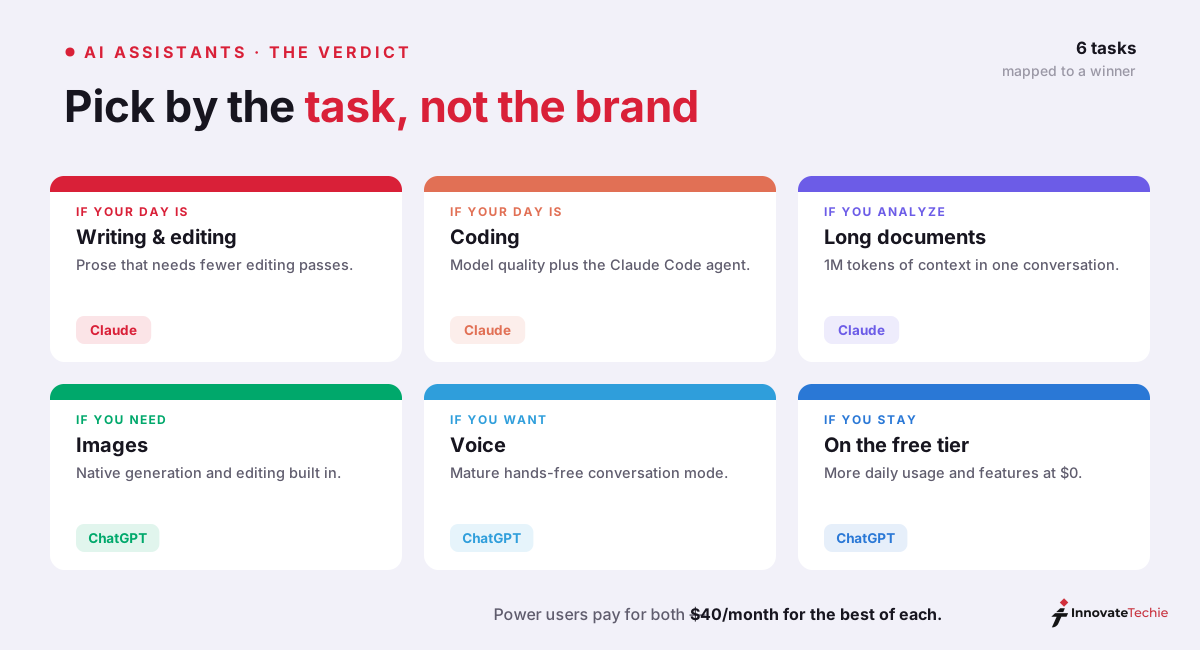
- Do you need images or voice? → ChatGPT.
- Is your job mostly writing, code, or long documents? → Claude.
- Will you stay on the free tier? → ChatGPT.
- Still unsure? → Run both free tiers on one real task from your actual work — not a toy prompt. The difference in your domain will be obvious within a day.
Claude pricing at a glance
| Plan | Price |
|---|---|
| Free | $0 |
| Pro | $20 / month |
| Max | from $100 / month |
| API | Pay per token |
For the full breakdown of every plan, see our how much Claude costs guide.
Frequently Asked Questions

Written by
InnovateTechie
Writing about Claude and the Anthropic toolkit — models, Claude Code, pricing, features, and fixes, in clear, practical, hands-on guides tested by daily use.
View all posts →