

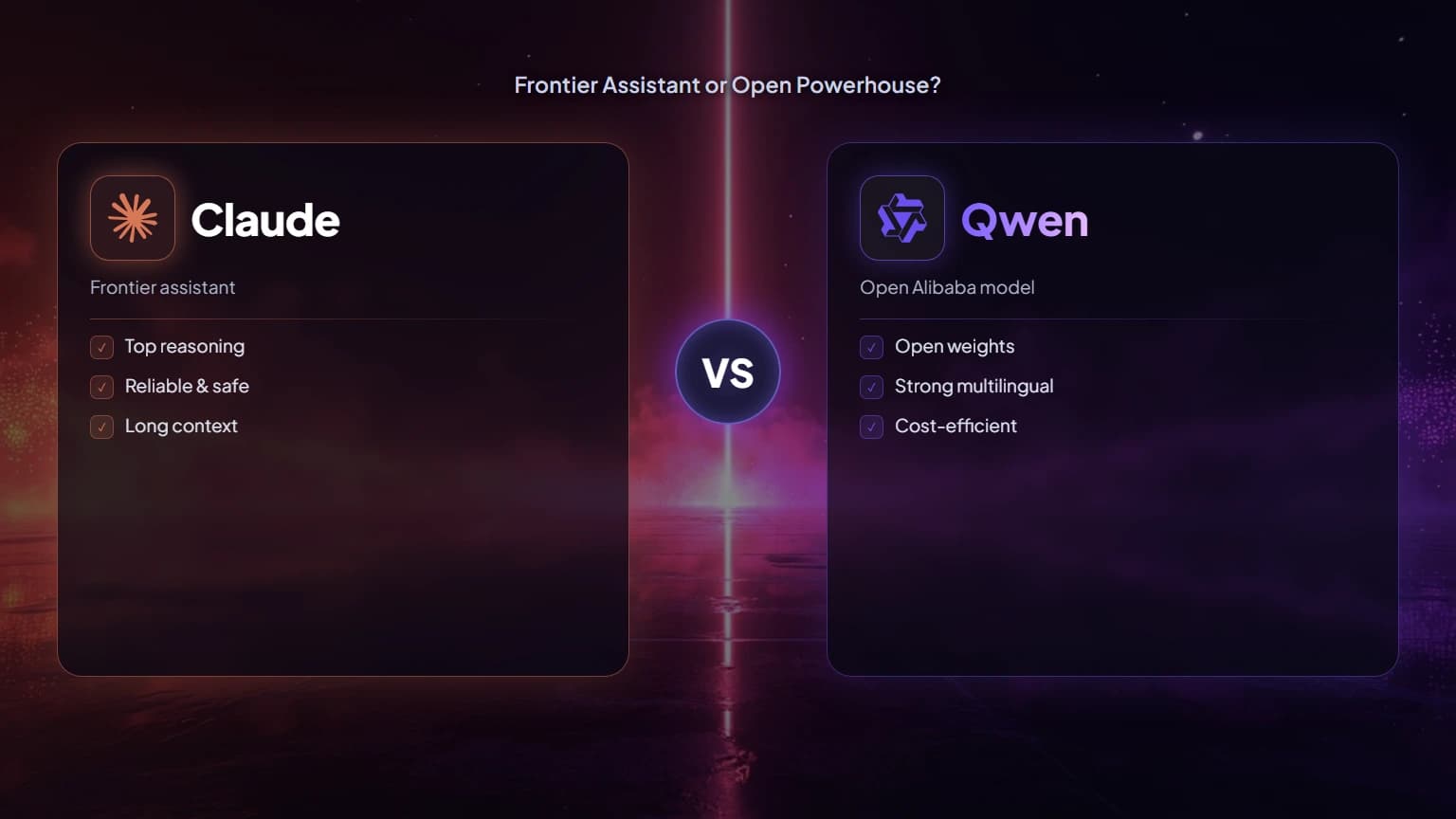
Part ofClaude vs Everything: The Complete Claude Comparison
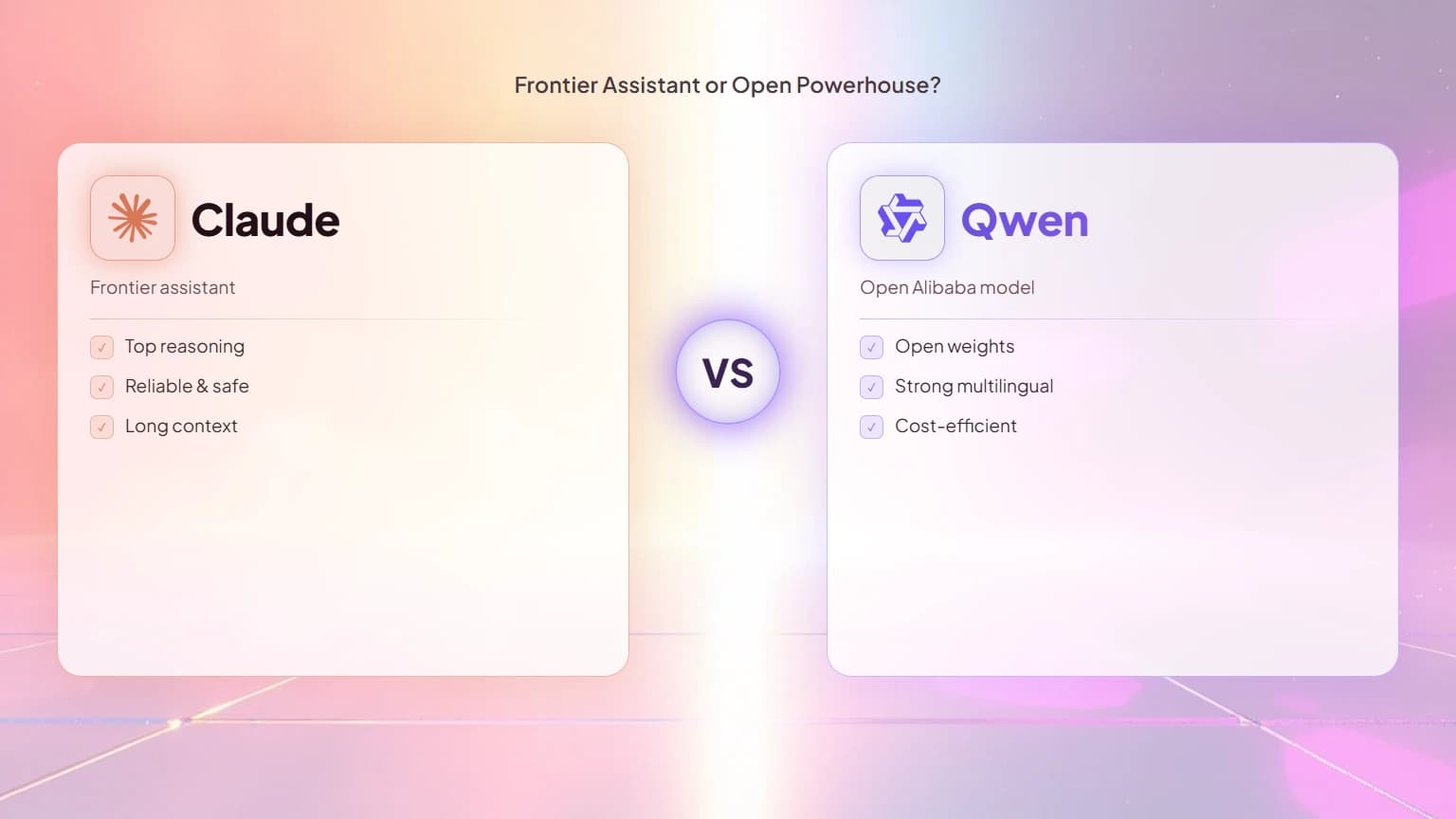
Claude is the managed frontier — safety, polish, agentic coding; Qwen is Alibaba's open, multilingual, low-cost powerhouse you can self-host. An honest verdict.
In This Article
8 sectionsIn the Claude vs Qwen matchup, Claude wins on frontier reliability, safety, and agentic coding, while Qwen counters with open Apache-2.0 weights you can self-host, standout multilingual range across 119 languages, and cost up to 13x lower per token. Pick Claude for polished, high-stakes output; pick Qwen for openness, languages, and price.
We run both in production — Claude Code against our own repository, self-hosted Qwen for high-volume, multilingual batch jobs where per-token fees would sink the budget. This guide is part of our wider Claude comparison hub, and it settles the Claude vs Qwen question the way buyers actually ask it: coding, reasoning, languages, price, openness, and the honest line where each one wins.
Claude vs Qwen: the one-minute verdict
The Claude vs Qwen fight is a clash of two opposite bets — the same open-versus-managed axis we mapped in our Claude vs DeepSeek and Claude vs Llama breakdowns — only Qwen plays both sides. Anthropic sells closed, frontier-grade reliability you rent through an API or apps. Alibaba's Qwen team ships most of its family as open weights under the permissive Apache 2.0 license, prices its hosted API aggressively, and lets you run the model yourself — yet keeps its very top Qwen-Max flagship closed and API-only. Almost every row below follows from that split.
| Claude (Anthropic) | Qwen (Alibaba) | |
|---|---|---|
| Current lineup | Opus 4.8, Sonnet 5, Haiku 4.5 | Qwen3 family, Qwen3-Coder, Qwen-Max |
| Model access | Closed — API and apps | Mostly open weights; Max is closed |
| License | Proprietary | Apache 2.0 (open models) |
| Context window | Up to 1M tokens (200K standard) | 1M-token variant; 128K–256K standard |
| Languages | Strong English + European | 119 languages; leads Chinese/CJK |
| Image generation | No | No |
| Data residency | US, enterprise controls | Self-host, or Alibaba Cloud |
| Signature strength | Reliability, safety, polish | Openness, languages, low cost |
Framed simply, the Qwen vs Claude choice is open, multilingual value against managed frontier reliability. Hand both the same messy repo and vague ticket: Qwen returns working code cheaply and speaks a dozen languages fluently, while Claude returns the diff you'd merge without a rewrite. That trade is the whole Claude vs Qwen comparison in miniature.
Claude vs Qwen for coding
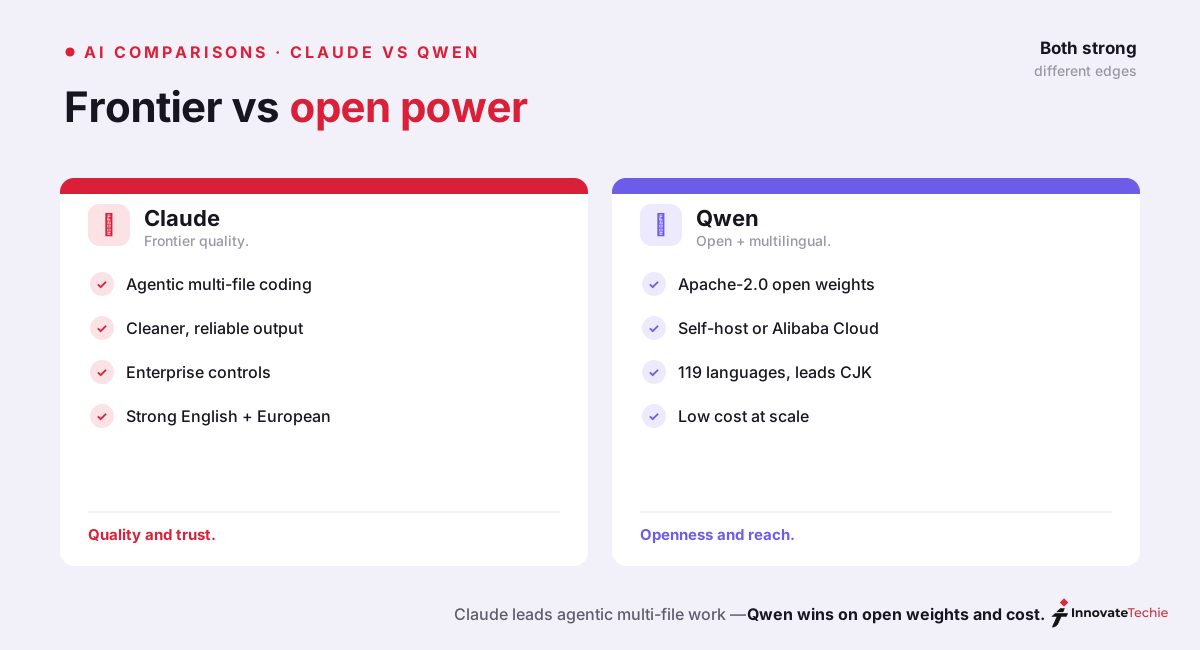
Coding is where most buyers start, and the honest answer is that both are strong — Qwen is closer than most rivals. On single-function generation the gap is thin: Claude leads HumanEval at roughly 92% to Qwen's high-80s, close enough that the benchmark barely separates them. Qwen3-Coder, Alibaba's dedicated 480B mixture-of-experts coding model, matches Claude Sonnet-tier models on agentic coding benchmarks and posts state-of-the-art SWE-bench Verified scores among open-weight models.
Where Claude pulls ahead is the hardest agentic engineering. Claude Opus 4.8 tops the punishing SWE-bench Pro suite at 69.2%, and in daily use that shows up as maintainable, deployment-ready diffs: Claude keeps multi-file refactors coherent, matches your existing style, and produces edits you can review instead of re-read line by line. Anthropic also ships Claude Code, a first-party agentic coding tool; Qwen's answer, Qwen Code, is a capable free CLI fork but still trails on complex, tool-heavy work.
| Coding dimension | Claude | Qwen |
|---|---|---|
| HumanEval (single-function) | ~92% | High-80s, near-parity |
| SWE-bench Pro (agentic) | 69.2% (Opus 4.8) | Trails; strong for an open model |
| SWE-bench Verified (agentic) | Frontier | SOTA among open weights |
| Multi-file production refactors | Cleaner, deployment-ready | Capable, less consistent |
| First-party coding agent | Claude Code | Qwen Code (open CLI) |
| Cost per coding session | Higher | Up to ~13x lower |
The claude vs qwen coding verdict we've landed on: reach for Qwen when the task is self-contained generation, a script you'll read once, or work you'll host yourself on a budget, and reach for Claude when the code has to survive in a codebase other people maintain. The same quality-first pattern holds against OpenAI — we walk through it in Is Claude better than ChatGPT?.
Languages, reasoning, and context
If there's one axis where Qwen genuinely leads Claude, it's languages. Qwen3 was trained across 119 languages and dialects, per Qwen's official model notes, and it's the stronger model for Chinese, Japanese, and Korean. For those markets, and for structured, research-heavy long-form work, Qwen is often the better writer. Claude's counter is English and European pairs — German, French, Dutch, Italian, Spanish, Arabic — where its prose reads more natural and nuanced, and it's still the model most professionals rate first for polished English, a gap we cover in Claude for writing.
On reasoning, Claude's edge is judgment: following layered instructions, weighing trade-offs, and staying honest under uncertainty instead of confidently inventing an answer. Qwen is strong on structured, quantitative, STEM-style problems and ships explicit thinking and non-thinking modes you can toggle per request. On context, Qwen advertises a 1M-token variant that matches Claude's up-to-1M ceiling, though most open Qwen3 models ship 128K–256K and Claude's standard window is 200K; our Claude context window guide covers why usable recall diverges from the advertised number.
Pricing and openness
On price, the Claude vs Qwen gap is wide and real. Qwen's open models are free to download and run under Apache 2.0, and even its hosted API undercuts Claude heavily — output tokens on Qwen's mainstream models run roughly 13x cheaper than Claude Opus 4.8. Claude Opus 4.8 lists at $5 input and $25 output per million tokens, Claude Sonnet 5 at $2/$10 during its introductory window, and Haiku 4.5 at $1/$5, per Anthropic's published pricing. On the consumer side, Qwen is free through Alibaba's Qwen Chat and Tongyi app, while Claude's paid plans start at $20/month for Pro and climb to $100–$200 for Max.
| Tier | Claude (Anthropic) | Qwen (Alibaba) |
|---|---|---|
| Free consumer chat | Yes — tight caps | Yes — Qwen Chat / Tongyi app |
| Entry paid plan | Pro — $20/mo | None needed (free tier) |
| Budget API model | Haiku 4.5 — $1/$5 per 1M | Qwen open models — cents per 1M |
| Flagship API model | Opus 4.8 — $5/$25 per 1M | Qwen-Max — well under Opus |
| Open weights / self-host | No | Yes — Apache 2.0 (most models) |
Two honest points before you switch. First, Qwen's Apache 2.0 license is more permissive than Meta's Llama Community License — no monthly-active-user ceiling, no ban on training competing models — so for open-weight purists it's the cleaner license. Second, cheap tokens only stay cheap if you don't re-verify the output; on the hardest agentic tasks the re-work Claude saves can erase Qwen's per-token savings. Our Claude API pricing guide breaks down the managed side in detail.
Privacy, self-hosting, and data control
This is where the claude or qwen decision stops being about quality and becomes about control. Qwen's defining advantage is that its open models — everything up to the 235B-parameter Qwen3 — can be downloaded and run entirely on your own hardware, air-gapped, with no prompt ever leaving your network. For regulated industries or teams that can't send data to a third party, that capability alone can decide the evaluation. Claude offers nothing equivalent: Anthropic's models are closed and reachable only through its cloud API.
Claude's counter is what its default hosted path already ships: US data residency, enterprise agreements, a commitment not to train on business API traffic, and stronger safety guardrails out of the box. Qwen's own hosted service runs on Alibaba Cloud under Chinese jurisdiction, a genuine consideration for Western enterprises handling sensitive data — but the escape hatch is real, because you can self-host the open weights and keep everything in-house. The alibaba qwen vs claude trade is clean: Qwen hands you data control by letting you hold the model; Claude hands you data protection by managing it under enterprise terms so you don't have to.
Running Claude Code with Qwen
A popular middle path collapses the Claude vs Qwen choice into one workflow: point Claude Code at Qwen instead of Anthropic's models. Claude Code speaks the Anthropic API format, so a small translating proxy lets it drive a Qwen model — hosted or self-hosted — as the backend, running a full coding session for a fraction of Opus rates. It's the same routing trick we cover in running Claude Code with OpenRouter and our Claude Code router guide. The catch is exactly the coding gap above: you get Qwen's output quality inside Claude's agent loop, so complex multi-file work still needs a closer review than Opus would.
The task-by-task verdict
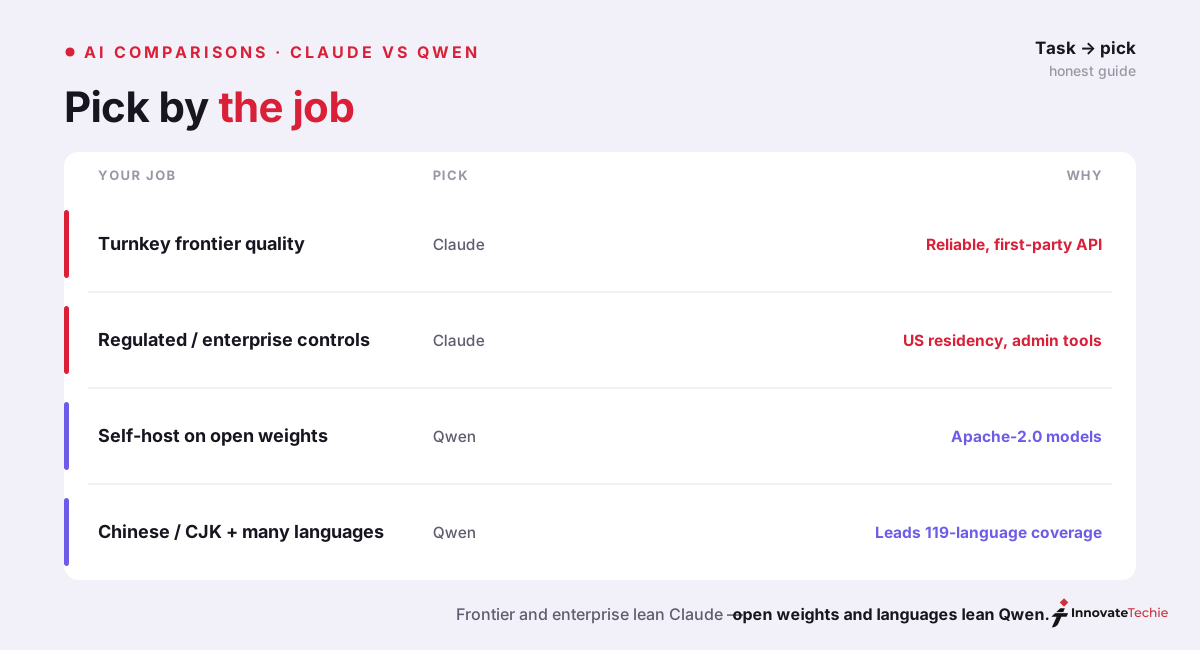
No single winner survives contact with real work, so here's the honest Claude vs Qwen call by use case:
| Your main task | Better pick | Why |
|---|---|---|
| Production, client-facing code | Claude | Deployment-ready, maintainable diffs |
| Budget or high-volume generation | Qwen | Up to ~13x cheaper per token |
| Chinese / Japanese / Korean work | Qwen | Trained across 119 languages |
| Polished English writing | Claude | More natural, nuanced prose |
| Nuanced instruction-following | Claude | Fewer confident errors, better judgment |
| Self-hosting / air-gapped | Qwen | Open Apache-2.0 weights you run |
| Sensitive data under contract | Claude | US residency, no-train guarantees |
| Long agentic coding sessions | Claude | Claude Code, fewer compounding errors |
The Claude vs Qwen pattern is consistent: Qwen is the open, multilingual value play you pick when cost, languages, or self-hosting is the binding constraint; Claude is the reliability play you pick when the quality of one output — or the sensitivity of the data behind it — matters more than the invoice. Plenty of teams run both and route by task, exactly as we recommend across the field in our Claude vs Gemini breakdown.
The quick version:
- Claude leads agentic coding, safety, and polished English
- Qwen leads cost, 119-language multilingual range, and open weights
- Qwen self-hosts under Apache 2.0; Claude keeps US data residency
- Both offer a 1M-token context option
For example, on the same production refactor across 20 files, Claude shipped a cleaner agentic diff, while Qwen matched it on raw generation speed at roughly a thirteenth of the API cost.
Claude pricing at a glance
| Plan | Price |
|---|---|
| Free | $0 |
| Pro | $20 / month |
| Max | from $100 / month |
| API | Pay per token |
For the full breakdown of every plan, see our how much Claude costs guide.
Frequently Asked Questions

Written by
InnovateTechie
Writing about Claude and the Anthropic toolkit — models, Claude Code, pricing, features, and fixes, in clear, practical, hands-on guides tested by daily use.
View all posts →