




Part ofClaude Models Explained: Opus vs Sonnet vs Haiku
Claude API pricing per million tokens: Opus 4.8, Sonnet and Haiku rates, batch's 50% cut, prompt caching, and worked cost examples.
In This Article
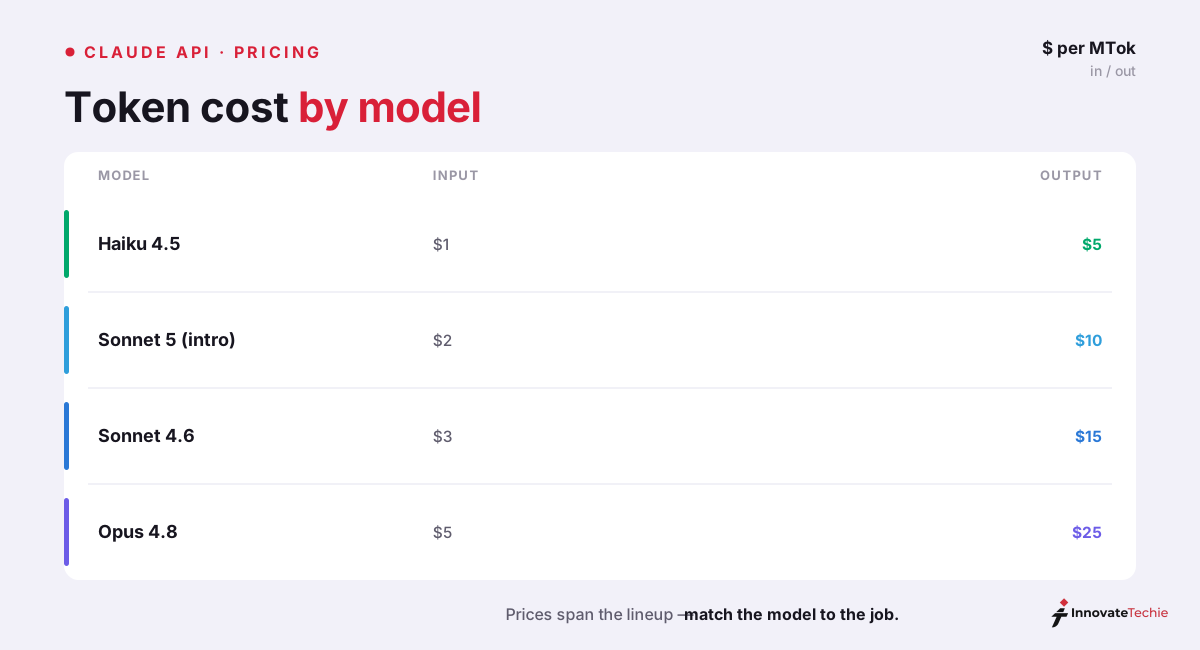
6 sectionsClaude API pricing is pay-as-you-go by the token, with no monthly fee: Claude Haiku 4.5 costs $1/$5 per million input/output tokens, Claude Sonnet 4.6 costs $3/$15, and Claude Opus 4.8 costs $5/$25. Output is billed at 5x input across every model, and batching or prompt caching can cut effective costs by up to 95%.
We run this site's content pipeline on the Claude API, so we watch these numbers closely. The good news for anyone budgeting a project: the whole system is per-token and transparent — no seat license, no minimum spend, no surprise tiers. This Claude API pricing guide breaks down every model's per-token rate, the three discount levers that matter most, worked cost examples you can copy, and a simple rule for picking a model by budget.
How Claude API pricing works
Every request bills two token streams separately: input tokens (your prompt, system message, and any documents) and output tokens (everything the model generates). Both are priced per million tokens — abbreviated MTok — and output always costs 5x input on current models. There is no monthly floor; you pay only for what you consume, which is what makes Anthropic API pricing predictable to forecast. Anthropic publishes the current rates per model, and they change only when a new model launches.
Roughly four characters equal one token, so a 750-word page is about 1,000 tokens. To estimate a bill before you're charged, multiply expected input and output tokens by the model's rate; to track real spend, read the usage object returned in every API response, which reports exact input and output counts per call. That habit — estimate, then reconcile against usage — is how you keep Claude API cost from surprising you.
Here is the full Claude API pricing table across the current lineup, including both discount columns:
| Model | Input / Output (per MTok) | Batch (−50%) | Cached input read (−90%) |
|---|---|---|---|
| Claude Opus 4.8 | $5 / $25 | $2.50 / $12.50 | $0.50 |
| Claude Sonnet 5 (standard) | $3 / $15 | $1.50 / $7.50 | $0.30 |
| Claude Sonnet 5 (intro, through Aug 31) | $2 / $10 | $1 / $5 | $0.20 |
| Claude Sonnet 4.6 | $3 / $15 | $1.50 / $7.50 | $0.30 |
| Claude Haiku 4.5 | $1 / $5 | $0.50 / $2.50 | $0.10 |
Two things stand out. First, the spread between the cheapest and most expensive model is only 5x, so model choice is about fit, not affordability. Second, Claude Sonnet 5 ships with an introductory rate of $2/$10 per million tokens through August 31, after which it settles to the standard $3/$15 — the same as Claude Sonnet 4.6. For a deeper tour of what each tier is built for, our Claude models explained guide covers the whole lineup.
The three levers that cut your Claude API cost
Base rates matter less than the discounts for any real workload — they are only half the Claude API pricing story. Three levers do the heavy lifting, and stacking them is where the savings compound.
| Lever | Discount | When it applies | Best for |
|---|---|---|---|
| Batch API | −50% flat | Async jobs, results within 24h | Nightly and bulk non-interactive work |
| Prompt caching (read) | −90% on cached input | Repeated, stable prefix | Agents, chatbots, long system prompts |
| 1M context window | No surcharge | Opus 4.8, Opus 4.7, Sonnet 5, Sonnet 4.6 | Whole-codebase and large-document requests |
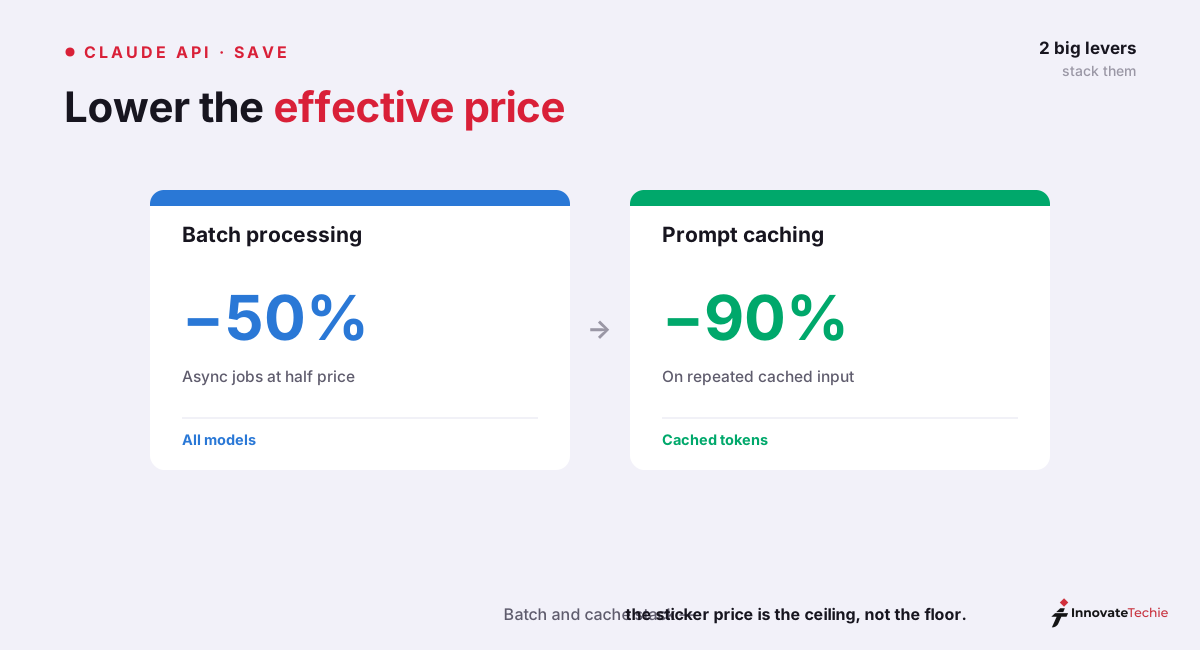
Batch processing takes 50% off every token when you submit jobs asynchronously and accept results within 24 hours. Any pipeline that isn't interactive — nightly summarization, bulk classification, report generation — should default to the batch API. Half price for changing one endpoint is the easiest win in Claude API pricing.
Prompt caching is the bigger lever for chat and agent apps. When requests share a long, stable prefix — a system prompt, a codebase snapshot, a document under discussion — prompt caching lets you reuse it. Cache reads cost 10% of the standard input price, a 90% discount, while the one-time cache write costs 1.25x input for a 5-minute cache or 2x for a 1-hour cache. Agents re-send that prefix on every turn, so caching routinely cuts effective input cost by 60–80% in our own logs.
The 1M-token context window carries no surcharge. Claude Opus 4.8, Claude Opus 4.7, and Claude Sonnet 5 support the full million-token context at flat standard rates — a 900K-token request pays the same per-token price as a 9K-token request. You still pay for the tokens you send, so filling a 1M window with Opus costs about $4.50 in input before output; caching exists precisely so you don't pay that repeatedly for the same material.
Worked Claude API pricing examples
Rates in the abstract are hard to feel. Here are five representative workloads with the arithmetic done, so you can anchor your own estimates. Each uses list prices with no discounts applied unless the row says otherwise.
| Workload | Model | Input | Output | Approx. cost |
|---|---|---|---|---|
| Summarize a 10K-token doc | Haiku 4.5 | 10,000 | 500 | $0.013 |
| Review a 50K-token codebase | Sonnet 4.6 | 50,000 | 2,000 | $0.18 |
| Same review on the flagship | Opus 4.8 | 50,000 | 2,000 | $0.30 |
| 900K-token whole-repo request | Opus 4.8 | 900,000 | 4,000 | $4.60 |
| Chatbot turn, 20K cached prefix | Sonnet 4.6 | 1K + 20K cached | 800 | $0.021 |
The pattern to internalize: input dominates on document-heavy tasks, output dominates on generation-heavy ones, and caching flips the math on anything conversational. The chatbot row shows a cached 20K-token prefix costing $0.006 to read instead of $0.06 to reprocess cold — a 90% cut on the largest part of the request. Run those same batches asynchronously and every Claude API pricing figure in the table halves again.
How to pick a Claude model by budget
Claude API pricing rewards matching the model to the job, and the decision reduces to one question: what does a slightly wrong answer cost you? If mistakes are cheap to catch, buy speed and volume; if they compound invisibly, buy reasoning.
- Tight budget, verifiable outputs — classification, extraction, tagging, routing — use Claude Haiku 4.5 at $1/$5 and batch it. This is the cheapest Claude token pricing on offer, and errors surface immediately.
- Everyday coding and writing — use Claude Sonnet 5 (or 4.6). It delivers most of Opus's coding quality at roughly 40% of the price, and the introductory rate makes it cheaper still.
- Hardest reasoning and large refactors — use Claude Opus 4.8, which leads SWE-bench Pro at 69.2%. Reserve it for tasks where the failure cost justifies the premium.
Our standing rule is start on Sonnet, escalate to Opus only when Sonnet measurably fails, and downgrade to Haiku wherever outputs are mechanically verifiable. The Claude Sonnet vs Opus breakdown has the benchmark data and full cost math behind that call. If you weigh Claude against rival assistants on value rather than sticker rate, our Claude vs ChatGPT comparison shows where each one earns its price. Note that Claude Code — Anthropic's agentic coding tool — bills differently: it needs a paid subscription or API credits, as covered in What is Claude Code?.
Add-on and tool costs
Beyond text generation, a few server-side tools carry their own Claude API price per token or per use. These sit outside standard token rates and are billed on top of them.
| Add-on | Price | Notes |
|---|---|---|
| Web search | $10 per 1,000 searches | Result-processing tokens billed separately |
| Code execution | 50 free hours/day per org, then $0.05/hour | Free when paired with web search or fetch |
| Batch processing | −50% on all tokens | Results returned within 24 hours |
| Prompt cache write | 1.25x input (5-min) / 2x (1-hour) | One-time write premium before reads |
Web search costs $10 per 1,000 searches, with the tokens for processing results billed separately at the model's normal input rate. Code execution includes 50 free hours daily per organization — and is free entirely when paired with web search or web fetch — then $0.05 per hour beyond that. For most projects these add-ons are a rounding error next to token spend, but they matter at scale, and they are the part of Claude API pricing teams most often forget to forecast.
Claude pricing at a glance
| Plan | Price |
|---|---|
| Free | $0 |
| Pro | $20 / month |
| Max | from $100 / month |
| API | Pay per token |
For the full breakdown of every plan, see our how much Claude costs guide.
Frequently Asked Questions

Written by
InnovateTechie
Writing about Claude and the Anthropic toolkit — models, Claude Code, pricing, features, and fixes, in clear, practical, hands-on guides tested by daily use.
View all posts →