


Part ofClaude vs Everything: The Complete Claude Comparison
Claude (via Claude Code) delegates whole tasks; GitHub Copilot completes code inline. Head-to-head table, pricing, IDE reach, and a verdict by workflow.
In This Article
8 sectionsIn the Claude vs Copilot decision, GitHub Copilot wins on inline autocomplete, IDE reach, and price ($10/month), while Claude — through Claude Code — wins on agentic, repo-wide tasks you delegate whole. Copilot is the productivity layer inside your editor; Claude Code is the terminal agent that plans, edits files, and runs your tests until they pass.
We run both every week on this codebase, and the honest verdict is that neither one "wins" outright — they're built for two different jobs. Copilot makes you faster keystroke by keystroke. Claude Code takes a whole ticket off your plate. Below is the head-to-head table, the real pricing, the IDE-reach gap, and a verdict sorted by workflow so you can pick in two minutes. New to Anthropic's agent? Start with What Is Claude Code?, then come back.
Two tools, two jobs
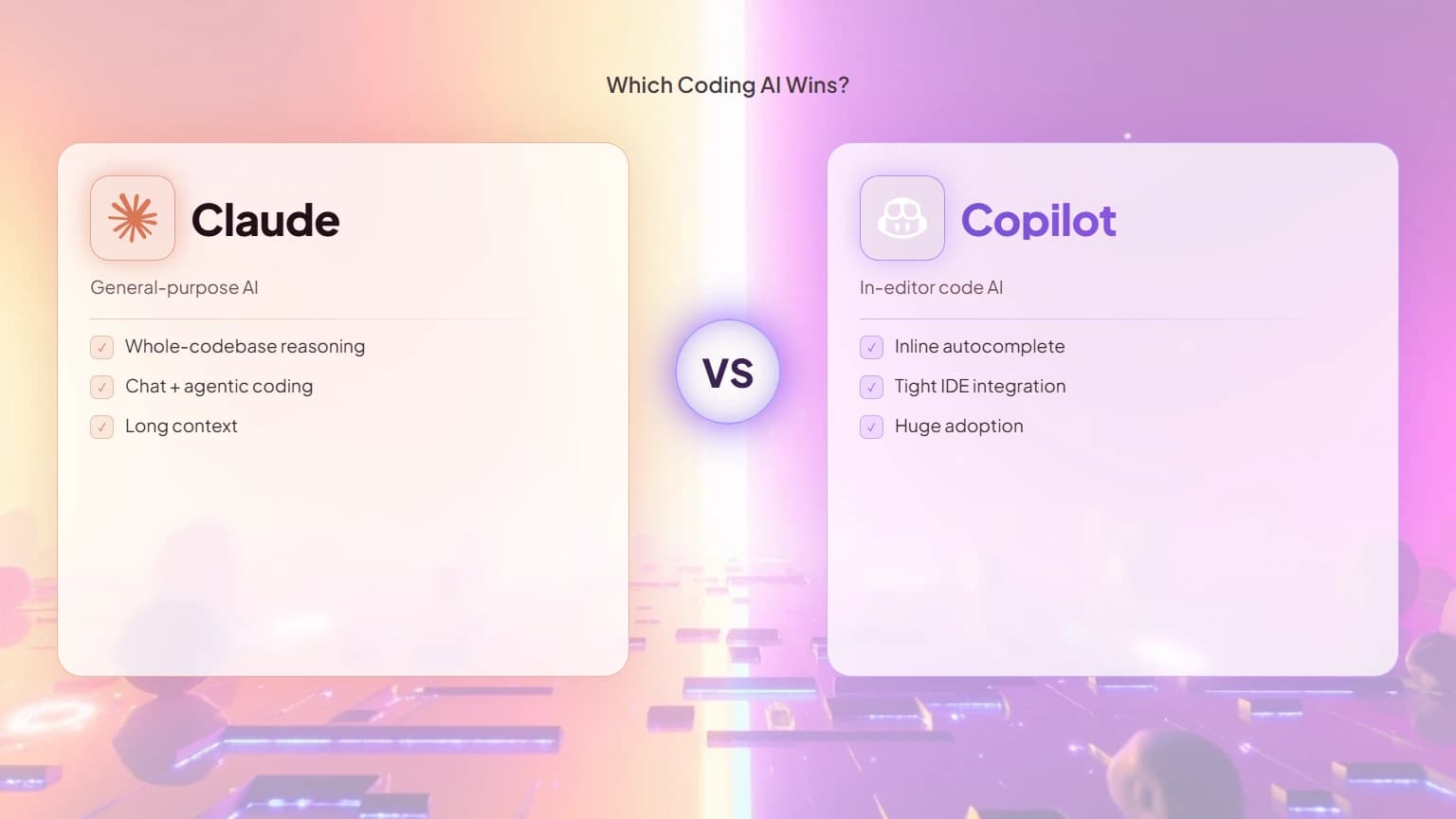
The Claude vs Copilot split is really a workflow split, not a quality contest. GitHub Copilot grew up as autocomplete: it watches your cursor and suggests the next line, the next function, the next edit, and you accept with Tab. That inline loop is its home turf, and nothing does it better. Copilot has since added a coding agent that opens pull requests, but its center of gravity is still the suggestion you accept without leaving the editor.
Claude Code starts from the opposite end. You describe a goal — "migrate these components to the new API," "add retry logic across the payment service" — and it reads the repo, drafts a plan, edits multiple files, runs your test suite, and iterates on failures. You review the result instead of guiding each keystroke. That agent-first design is why the "claude code vs copilot" debate keeps coming up: the two tools answer different questions about how you want to work.
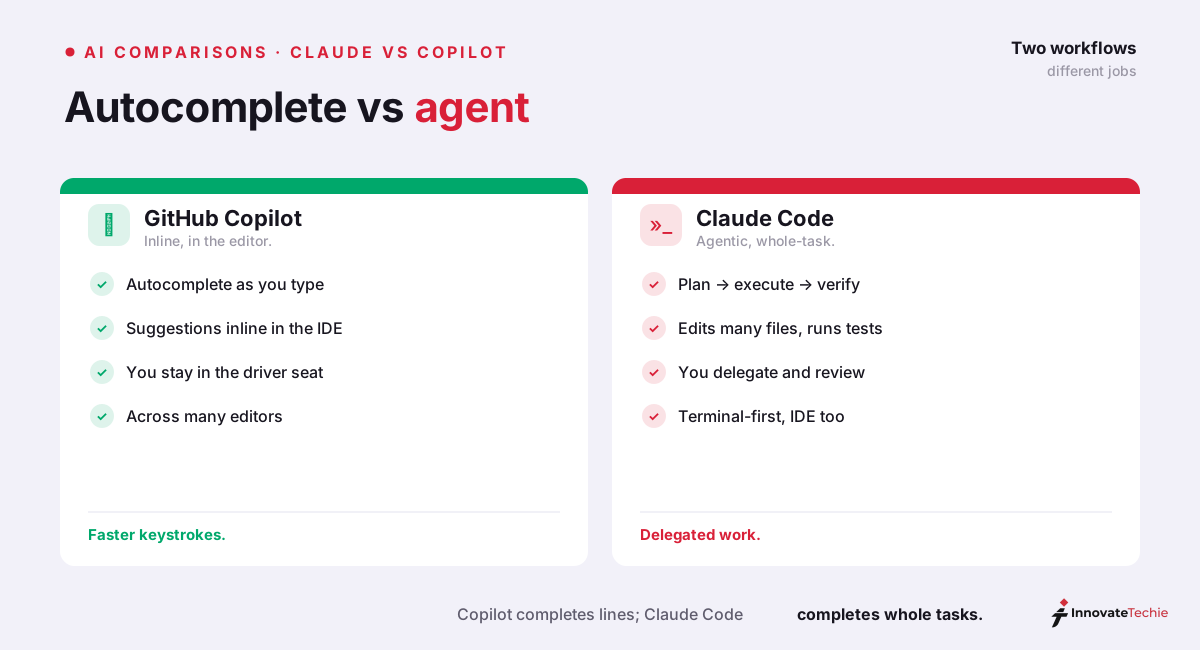
The shorthand we use: Copilot is a productivity layer embedded in your IDE; Claude is a reasoning engine you build with. Ask "what should the next line be?" and Copilot is unbeatable. Ask "make this change across twelve files and don't break the tests" and Claude Code is the tool you want.
Claude vs Copilot: head-to-head comparison
Here's the Claude vs Copilot matchup on the dimensions that change your day, with Claude represented by Claude Code since that's the head-to-head developers actually mean:
| Claude (via Claude Code) | GitHub Copilot | |
|---|---|---|
| Core model of work | Agent-first: delegate whole tasks | Autocomplete-first: assist as you type |
| Home turf | Repo-wide, multi-file reasoning | Inline completions in the editor |
| Where it runs | Terminal, VS Code, JetBrains, desktop, web | VS Code, Visual Studio, JetBrains, Neovim, Xcode, Eclipse, Zed |
| Models | Claude Opus 4.8, Sonnet 5, Haiku 4.5 | GPT-5.x, Claude, Gemini — you pick |
| Agentic mode | Native plan → execute → verify loop, no session cap | Coding agent: one repo per session, one PR per task, ~59-min cap |
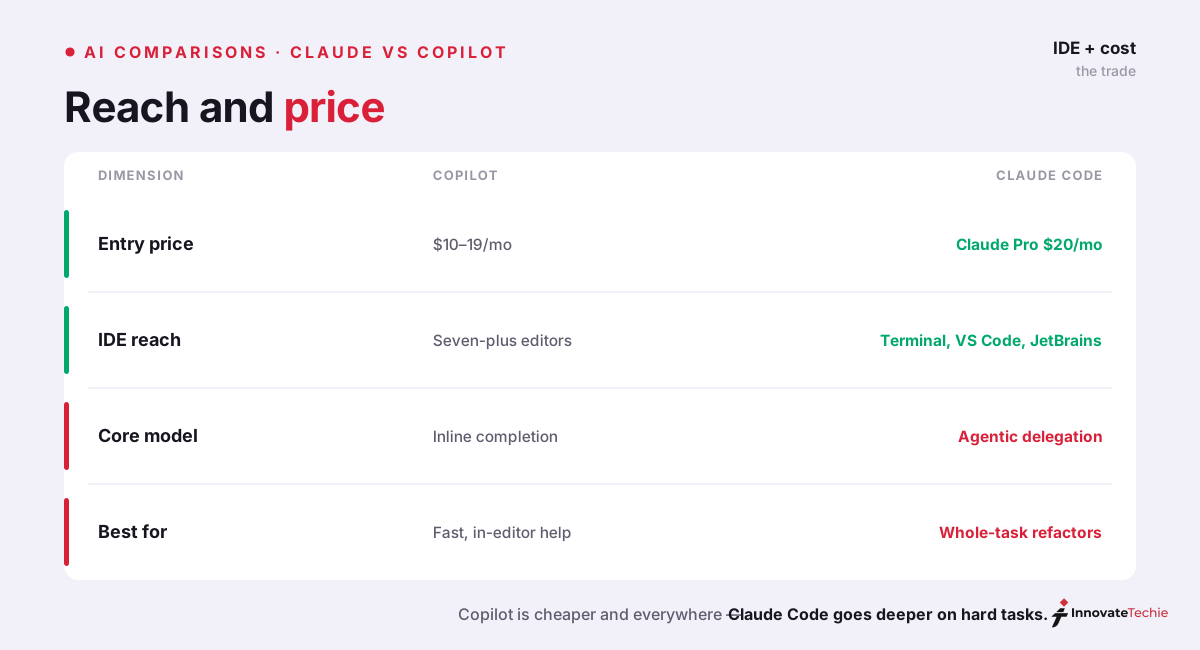
| Entry price | Claude Pro $20/month (or API) | Copilot Pro $10/month |
| Power tier | Max $100–200/month | Pro+ $39/month; Business $19/user/month |
| Best at | Autonomous refactors, whole-feature delegation | Fast inline suggestions, PR review, broad IDE reach |
Two rows deserve a footnote. First, "Models": Copilot is model-agnostic and now lets you run Claude models inside it — so the real contrast is delivery (inline vs agentic), not the underlying intelligence. Second, "Agentic mode": Copilot's autonomous coding agent enforces hard session limits, while Claude Code runs an unbounded local loop but is gated instead by your Claude plan's usage window.
The models behind each
Models are where the Claude vs Copilot comparison turns counterintuitive. Copilot's strength here is choice. Because it's a delivery layer, it plugs into GPT-5.x, Claude, and Gemini, and you switch models per request. That flexibility is genuine, and for a team that wants one autocomplete engine over many backends, it's a real advantage.
Claude Code runs Anthropic's models exclusively — a constraint if you like vendor-switching, a feature if you want Claude's coding strength dialed all the way up. The lineup: Claude Opus 4.8 (the flagship, which leads SWE-bench Pro at 69.2%), Claude Sonnet 5 (the everyday default), and Claude Haiku 4.5 (fast and cheap). You switch mid-session and escalate to Opus only when a task actually needs it. On raw coding benchmarks, Opus 4.8's 69.2% SWE-bench Pro score is the number to beat, and it's a big reason people reach for Claude on the hardest multi-file work — which is also the crux of the broader question of the best AI for coding.
Pricing: what each actually costs
Every Claude vs Copilot cost comparison lands on the same headline: Copilot is cheaper, full stop. Copilot Pro is $10/month with unmetered inline completions; Claude Pro is $20/month and gates you by 5-hour usage windows. The full picture:
| Claude (Claude Code) | GitHub Copilot | |
|---|---|---|
| Free option | API trial credits only | Copilot Free — limited completions |
| Entry paid | Claude Pro $20/month | Copilot Pro $10/month |
| Power / team | Max 5x $100 · Max 20x $200/month | Pro+ $39/mo · Business $19/user · Enterprise $39/user |
| Pay-per-token | Full API access | Usage-based AI credits (since June 1) |
| Cost profile | Spiky — agent runs burn real compute | Flat and cheap — completions don't meter |
Why the gap? Claude Code is agent-first, and every task runs a plan-execute-verify loop that reads more context and burns more compute than an inline suggestion ever will. On the API, Claude Code runs on Anthropic's published pricing — Claude Opus 4.8 at $5/$25 per million input/output tokens, Claude Sonnet 5 at introductory $2/$10 (until August 31, then $3/$15), and Claude Haiku 4.5 at $1/$5. Copilot bills a flat subscription plus AI credits after its June 1 shift to usage-based billing, but code completions stay included and don't touch that meter.
So if raw cost is the whole question, copilot vs claude isn't close — Copilot wins. The nuance is that you're not buying the same thing: $10 buys smart autocomplete, while Claude Code's higher ceiling buys delegated, whole-task work that would otherwise cost you an afternoon.
IDE integration and reach
This is Copilot's clearest, most decisive win. GitHub Copilot runs natively in VS Code, Visual Studio, JetBrains, Neovim, Xcode, Eclipse, and Zed — seven-plus first-class editors — so whatever your team already uses, Copilot is there with zero workflow change. For a shop split across multiple IDEs, that reach alone can settle the decision.
Claude Code is terminal-first. It ships official VS Code and JetBrains extensions, a desktop app, and a web version, but it doesn't pretend to live inside every editor. Its integration story is "run claude next to your code," which is powerful in the terminal and thinner if you never leave a niche IDE. In the Claude vs Copilot reach contest, Copilot wins on sheer editor count; Claude Code wins if the terminal is already your home.
When each one wins: the verdict by workflow
Forget the overall scoreboard and find your row. Here's the Claude vs Copilot verdict sorted by what you're actually trying to do:
| Your situation | Pick | Because |
|---|---|---|
| Inline autocomplete while you type | Copilot | Completions are its core, and they don't meter |
| Stay inside one editor, minimal setup | Copilot | Lowest change to how you already work |
| Cheapest possible AI coding | Copilot | Pro is $10/month with unmetered completions |
| Team spread across many IDEs | Copilot | Widest editor reach — seven-plus editors |
| Fast PR reviews and small edits | Copilot | Built into the GitHub review flow you use |
| Repo-wide, multi-file refactor | Claude Code | Plans across the whole codebase, verifies with your tests |
| Delegating a whole feature end-to-end | Claude Code | Agent-first plan → execute → verify loop |
| Highest quality on hard tasks | Claude Code | Claude Opus 4.8 leads SWE-bench Pro at 69.2% |
| Terminal-native workflow | Claude Code | Runs where your shell already lives |
The pattern is clean: the top half of that table is Copilot's inline, in-editor comfort zone; the bottom half is Claude Code's delegated, repo-scale territory. Most developers we know live in both halves depending on the hour.
Using both together
By far the most common setup we see isn't Claude vs GitHub Copilot as an either/or — it's both, splitting the day. Copilot stays open in the IDE for autocomplete, quick edits, and PR reviews; Claude Code runs in a terminal beside it for the heavy refactors and whole-feature work. Combined, that's roughly $30/month ($10 Copilot Pro + $20 Claude Pro), less than a single power tier of either.
The workflow is simple: accept Copilot's completions while you hand-write the fiddly bits, and when a task is too big to type your way through — a migration, a cross-cutting refactor, a test-suite buildout — you delegate it to Claude Code and review the diff. They don't compete for the same keystrokes, so there's no conflict. If you're also weighing editor-first agents or OpenAI's, our Cursor vs Claude Code and Codex vs Claude Code comparisons cover those two rivals in the same detail.
The Claude vs Copilot bottom line, compressed to three lines: pick Copilot if you mostly want smart autocomplete without changing editors; pick Claude Code if you delegate large, multi-file tasks and live in the terminal; run both if your week contains real amounts of each. Revisit the choice each quarter — this category moves faster than any tooling in memory, which is why this page carries an update date.
The quick version:
- Copilot autocompletes inline as you type
- Claude Code delegates and completes whole tasks
- Copilot starts at $10–19; Claude Pro is $20
- Many developers run both, for different moments
Claude pricing at a glance
| Plan | Price |
|---|---|
| Free | $0 |
| Pro | $20 / month |
| Max | from $100 / month |
| API | Pay per token |
For the full breakdown of every plan, see our how much Claude costs guide.
Frequently Asked Questions

Written by
InnovateTechie
Writing about Claude and the Anthropic toolkit — models, Claude Code, pricing, features, and fixes, in clear, practical, hands-on guides tested by daily use.
View all posts →