




Part ofClaude AI Features: The Complete Overview
Claude vision reads screenshots, photos, charts, and diagrams — OCR, chart analysis, and UI debugging. What it does, where it works, and its limits.
In This Article
7 sectionsClaude vision is Anthropic's image-understanding capability: upload a photo, screenshot, chart, or diagram and Claude reads it. It describes scenes, extracts text through OCR, interprets graphs, and debugs UI screenshots. Claude vision works in the claude.ai apps and the Claude API across the Claude 3 family and later — but it only reads images, it never generates them.
We use Claude vision every day on this site: pasting a broken layout into the chat, dropping a spreadsheet screenshot in to check a number, handing a design mockup to Claude Code. It is one of the most underused features Anthropic ships. Below we cover exactly how Claude sees, what image analysis it is good at, where it is available, the real limits, and the tips that separate a useful answer from a hallucinated one.
How Claude vision works: seeing in visual tokens
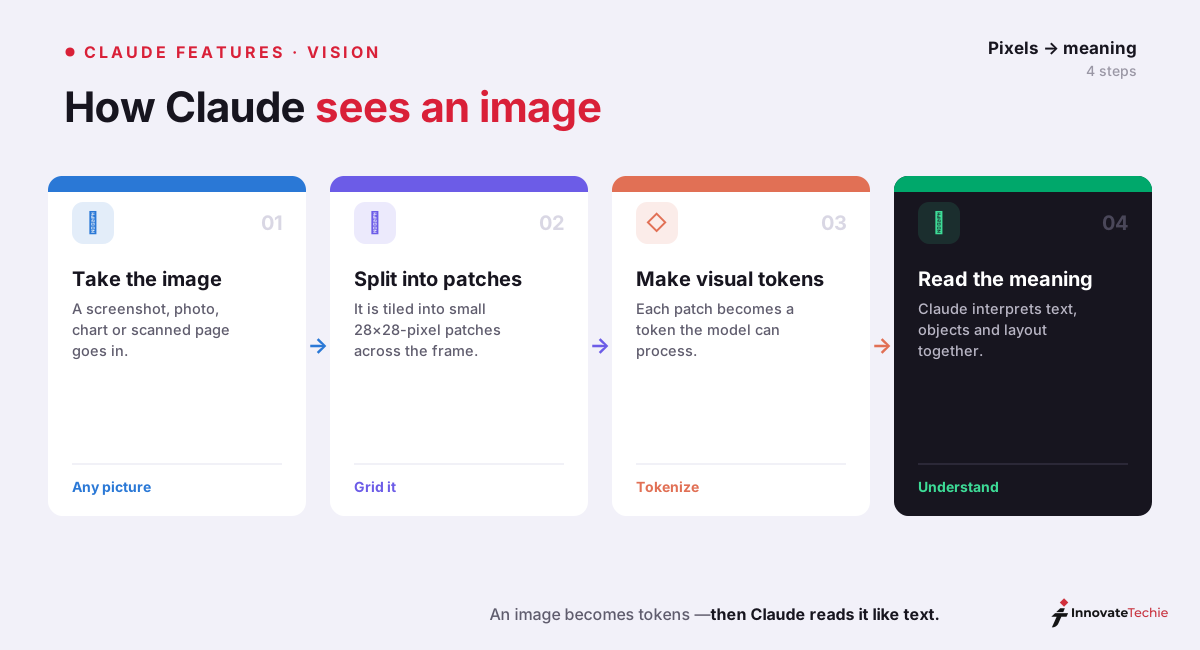
Claude does not "look at" an image the way an object detector does. It splits the picture into small patches — each a 28×28-pixel block that Anthropic calls a visual token — and reasons over those patches with the same architecture it uses for text. An image therefore costs roughly ⌈width / 28⌉ × ⌈height / 28⌉ visual tokens, which is why a large screenshot eats more of your context window than a thumbnail. Anthropic documents the full formula in its official vision guide.
The practical consequence is that Claude interprets rather than merely detects. It reads the relationship between a chart's axis label and its bars, ties a button's text to the error above it, and connects a code comment to the line it describes. That is what makes Claude vision feel like reasoning about an image instead of tagging objects in it. It is the same underlying skill behind Claude image analysis, whether you are asking a casual question in the app or wiring image blocks into a production pipeline.
What Claude vision can do
The short answer to "does Claude read images" is yes, and it goes well beyond captioning. Here are the jobs we hand to Claude vision most, with the kind of prompt that gets a clean result.
| Task | What Claude vision does | Example prompt |
|---|---|---|
| Describe an image | Summarizes scenes, objects, and layout in plain language | "What is happening in this photo?" |
| OCR / text extraction | Reads printed and handwritten text, tables, and code | "Transcribe the receipt in this image" |
| Chart and graph reading | Interprets trends, reads axes, answers data questions | "What was Q3 revenue in this bar chart?" |
| Screenshot analysis | Explains error dialogs, dashboards, and app states | "Why is this build failing?" |
| UI and design debugging | Spots misaligned elements, contrast issues, layout bugs | "What is wrong with this mobile layout?" |
| Document figures | Reads diagrams and images embedded inside PDFs | "Explain figure 3 in this paper" |
Claude OCR is the capability people underestimate most. When you ask Claude to analyze image text — a whiteboard photo, a scanned invoice, a screenshot of a stack trace — it transcribes printed and handwritten characters, preserves table structure, and can translate the result in the same turn. It is not a dedicated OCR engine, so tiny or low-contrast text still trips it up, but for everyday extraction it removes a whole tool from your workflow.
Claude vision vs computer use: seeing versus controlling
This is the distinction that trips people up, so we will draw it sharply. Claude vision means Claude can see a still image. Computer use means Claude can see a live screen and then act on it — moving a cursor, clicking, typing. Vision is the input; computer use is vision plus a control loop.
| Claude vision | Computer use | |
|---|---|---|
| Core action | Sees and interprets a still image | Sees a screen, then acts on it |
| Output | Text — a description, transcript, or answer | Tool calls — clicks, keystrokes, coordinates |
| You provide | An image you upload or pass to the API | A live screen plus permission to control it |
| Typical use | OCR, chart reading, screenshot Q&A | Automating a browser or desktop task |
If you just want an answer about a picture, that is Claude vision. If you want Claude to drive an application on your behalf, that is the separate, permission-gated capability we cover in Claude computer use. Every computer-use action starts with a vision step — Claude looks at a screenshot before it decides where to click — but the two are billed, gated, and reasoned about differently.
Where Claude vision is available
Claude vision is not a niche add-on; it ships almost everywhere Claude does. It sits inside the broader multimodal toolkit we map out in Claude AI features, and you reach it three ways:
- claude.ai apps (web, desktop, mobile). Upload an image like any file, or drag and drop it straight into the chat window. This is the fastest way to test whether Claude can analyze an image for your use case.
- Anthropic Workbench. A button to attach images appears on every user message block, handy for prototyping prompts before you ship them.
- The Claude API. Developers pass image content blocks as base64 data, a public URL, or a
file_idfrom the Files API. The Files API is the one to reach for in agentic loops, so you are not resending image bytes on every turn.
Two capabilities are worth calling out. First, you can send multiple images in one request and Claude analyzes them jointly — label them "Image 1", "Image 2" and ask it to spot the difference or read a multi-page document as a set. Second, Claude now sees images embedded inside PDFs, not just the text, so figures, charts, and screenshots inside a document are fair game. Supported formats are JPEG, PNG, GIF, and WebP; animations are not supported, so only the first frame of a GIF is read.
Claude vision limits (and how images are counted)
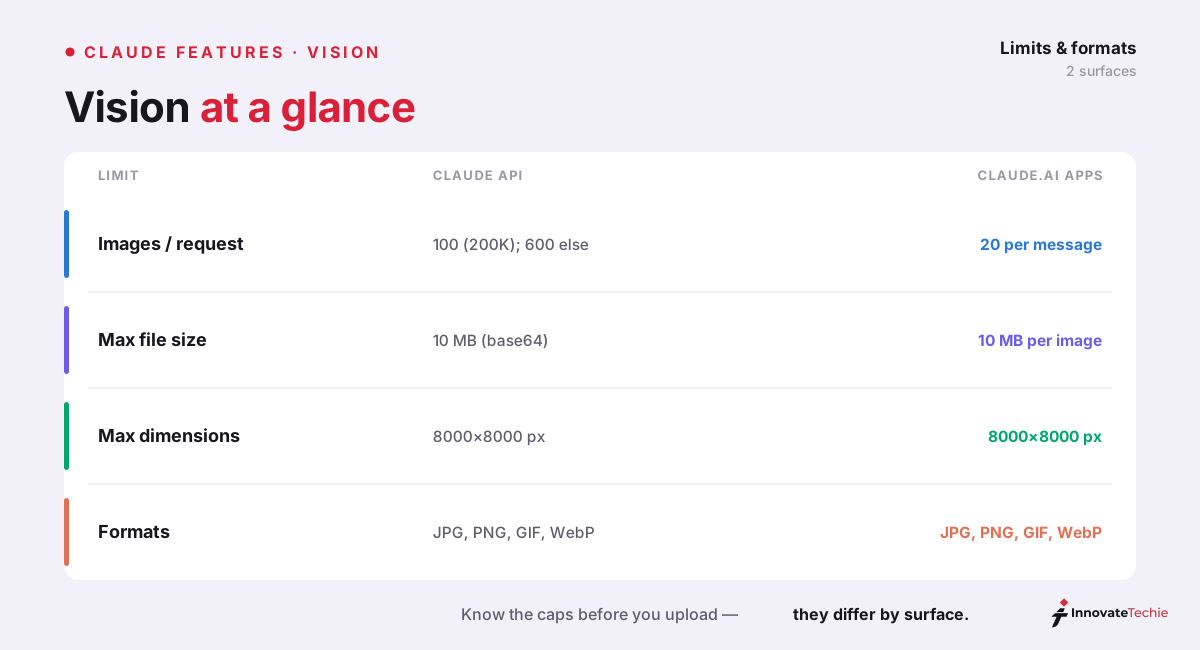
Claude vision is strong, but it is not magic, and knowing the edges saves you a bad answer. The hard numbers differ between the API and the consumer apps.
| Limit | Claude API | claude.ai apps |
|---|---|---|
| Images per request | 100 (200K-context models); 600 otherwise | 20 per message |
| Max file size | 10 MB per image (base64) | 10 MB per image |
| Max dimensions | 8000×8000 px | 8000×8000 px |
| Supported formats | JPEG, PNG, GIF, WebP | JPEG, PNG, GIF, WebP |
Resolution matters for cost and quality. On high-resolution models — Claude Opus 4.8, Opus 4.7, and Sonnet 5 — images downscale to a 2576-pixel long edge and up to 4784 visual tokens; other models cap at 1568 pixels. Anything larger is resized before Claude ever sees it, which can quietly shrink small text below readability. For the full picture on what each plan and endpoint accepts, see our guide to the Claude upload limit.
Then there are the capability limits, several of which are deliberate. Per Anthropic's acceptable use policy, Claude refuses to identify or name real people by their face. It does not read hidden EXIF or metadata — it only sees pixels. Counting many small objects is approximate, spatial and coordinate outputs are estimates, and Claude cannot reliably tell whether an image is AI-generated. It can read general medical images but is not a diagnostic tool for scans like CT or MRI. When precision is high-stakes, verify the output yourself.
Tips for better Claude vision results
Small changes in how you send an image move the accuracy needle a lot. This is the checklist we actually follow:
- Send the sharpest version you have. Blur, heavy JPEG compression, and rotation are the top causes of a wrong read. Crop to the region that matters rather than shrinking the whole frame.
- Keep important text legible. If you need Claude OCR on tiny print, zoom in and screenshot that section instead of the full page — resizing can push small text under the readable threshold.
- Put the image before your question. Claude performs best when the image precedes the text prompt, so lead with the picture and ask afterward.
- Label multiple images. When you want Claude to analyze image sets or compare two shots, name them so your follow-up questions have something to point at.
- Ask for structure. "Return the table as Markdown" or "list every error in order" gives you a parseable answer instead of a paragraph you have to re-read.
Claude pricing at a glance
| Plan | Price |
|---|---|
| Free | $0 |
| Pro | $20 / month |
| Max | from $100 / month |
| API | Pay per token |
For the full breakdown of every plan, see our how much Claude costs guide.
Frequently Asked Questions

Written by
InnovateTechie
Writing about Claude and the Anthropic toolkit — models, Claude Code, pricing, features, and fixes, in clear, practical, hands-on guides tested by daily use.
View all posts →