

Part ofClaude vs Everything: The Complete Claude Comparison
Perplexity searches the live web and cites sources fast; Claude reasons deeper for writing, coding, and analysis. A task-by-task comparison of both tools.
In This Article
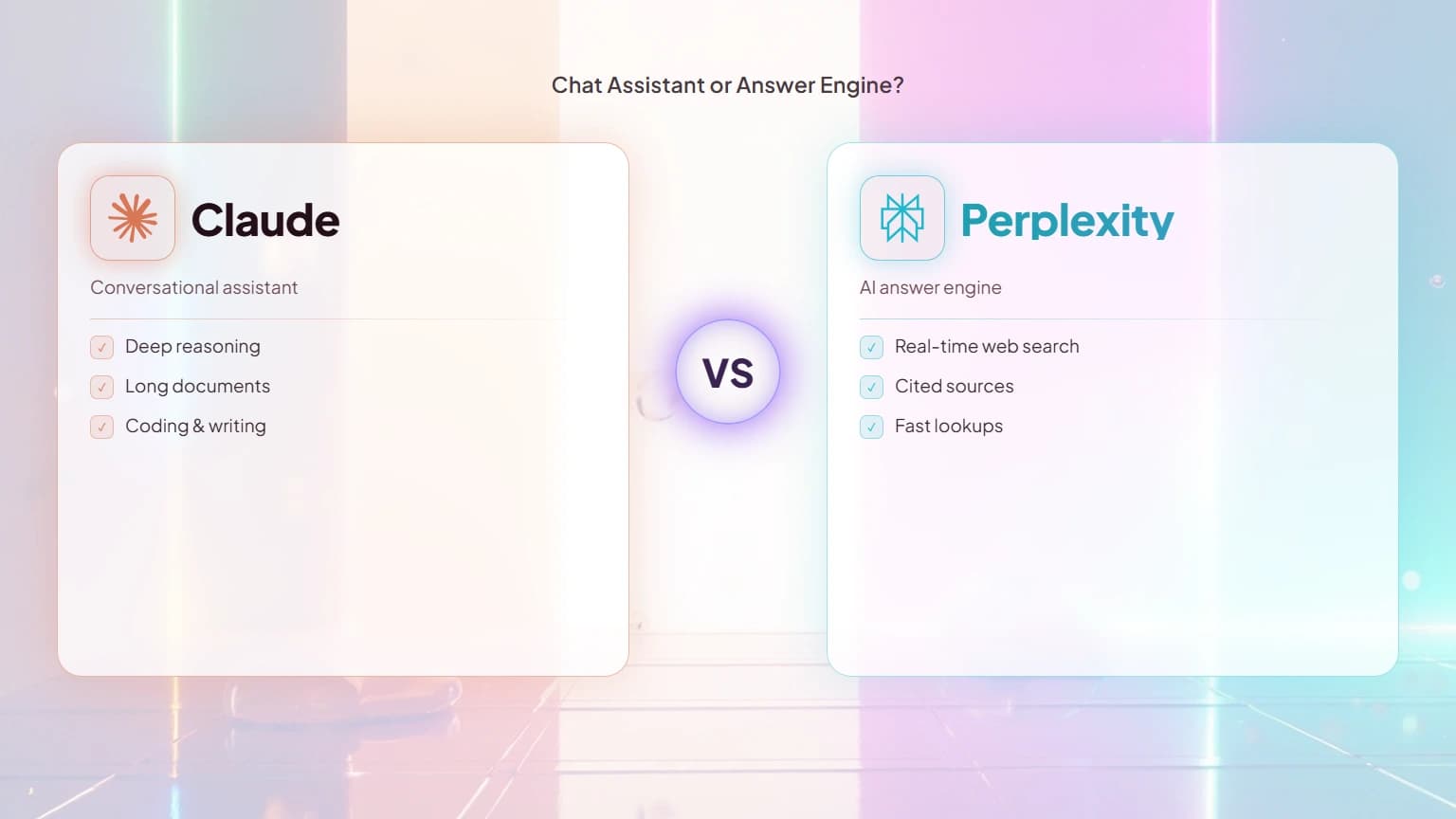
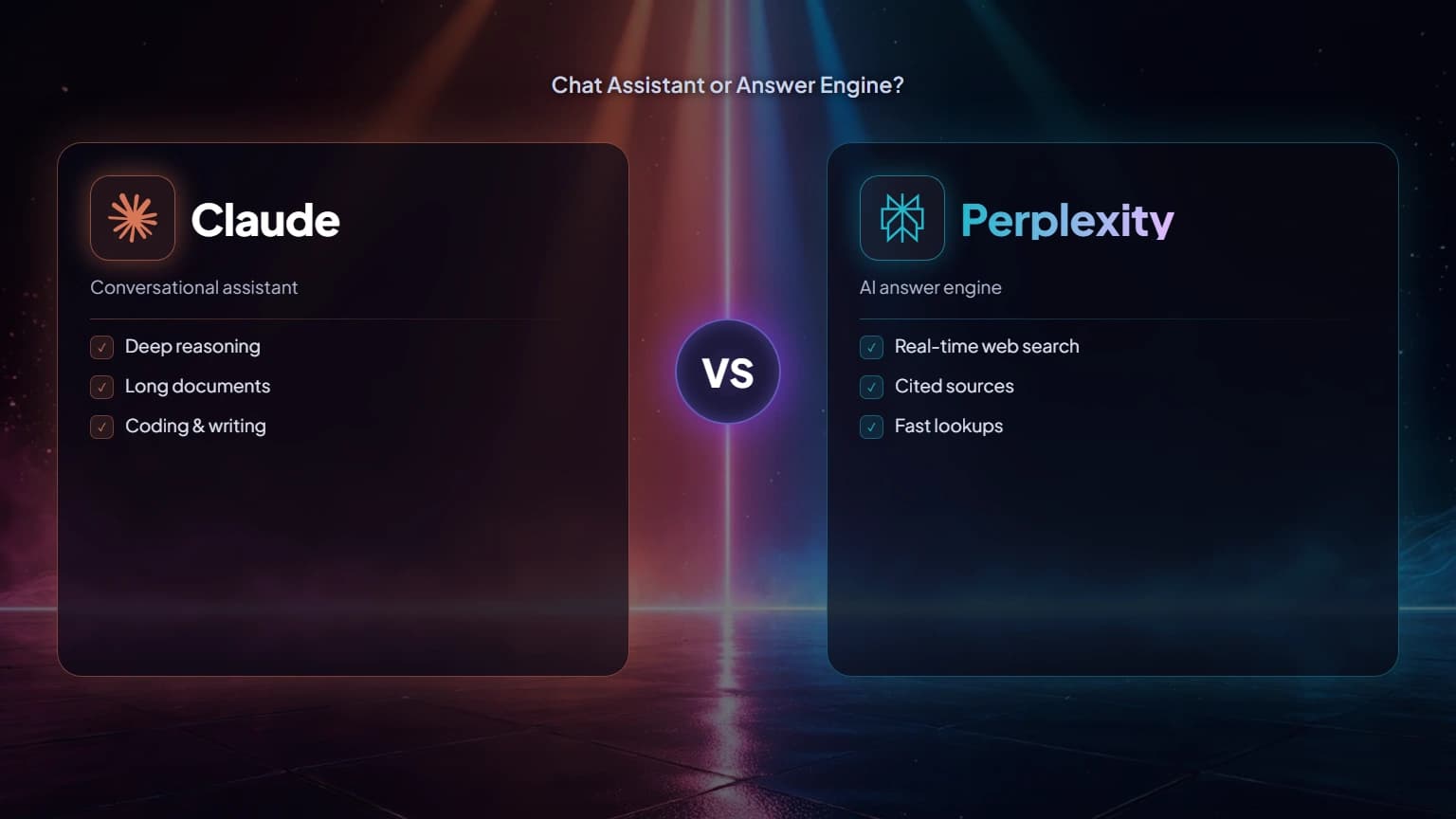
9 sectionsIn the Claude vs Perplexity decision, Perplexity is an answer engine that searches the live web and cites its sources in real time, while Claude is a conversational assistant built for deeper reasoning, long-form writing, and coding. Neither is universally better — Perplexity wins for fast, cited research, and Claude wins for building and analysis.
We run both tools in our own workflow every week — Perplexity to gather sourced facts fast, Claude to think through and write up what we found. This guide is part of our wider Claude comparison hub, and it settles the claude vs perplexity question task by task, honestly, because these two tools were built for different jobs.
Claude vs Perplexity: the one-minute verdict
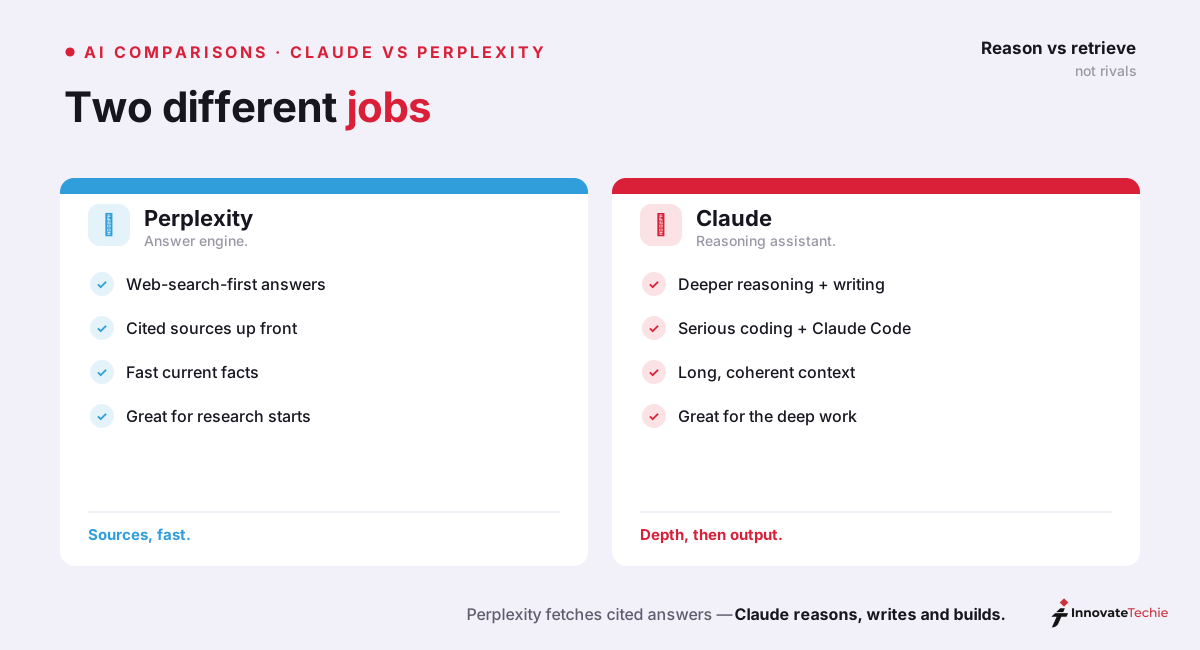
Perplexity and Claude look similar on the surface — you type a question, you get an answer — but they optimize for opposite things. Perplexity optimizes for retrieval: find current information on the open web and cite it. Claude optimizes for reasoning: think carefully over the material it's given and produce polished output. Almost every row in this claude vs perplexity comparison follows from that single split.
| Claude (Anthropic) | Perplexity | |
|---|---|---|
| Core job | Reasoning, writing, coding | Web search + cited answers |
| Default behavior | Reasons over what you give it | Queries the live web, cites sources |
| Standard paid plan | Pro — $20/mo | Pro — $20/mo |
| Premium tier | Max — $100–$200/mo | Max — $200/mo |
| Underlying model | Claude Opus 4.8, Sonnet 5 | Sonar, plus hosted GPT/Claude/Gemini |
| Best at | Deep work, long output | Fast, sourced research |
Retrieval vs reasoning: the core difference
The core difference is retrieval versus reasoning. Perplexity actively queries the web the moment you ask, pulls from live pages, then summarizes and footnotes every claim so you can click straight through to the source. Claude doesn't start by browsing — it reasons over the context you hand it, its training, and any files you upload, then produces structured, high-quality output. One fetches and cites; the other thinks and builds.
That design choice shapes everything else. Because Perplexity leads with search, it's hard to beat when the answer lives on a page published an hour ago — breaking news, a fresh product spec, a statistic you need with a citation already attached. Because Claude leads with reasoning, it's stronger when the job is interpreting, restructuring, or generating something long and coherent. In the perplexity vs claude ai debate, that's the line that never really moves.
Perplexity vs Claude for research
For research, the honest answer to perplexity vs claude is: it depends which half of research you mean. Gathering is Perplexity's home turf. Ask it a question and it returns a synthesized answer with numbered citations, the list of sources it read, and suggested follow-ups — the fastest path we've found from "I need to know X" to "here are five sourced facts about X." Its focus modes and file uploads narrow the search to academic papers or specific documents when you need rigor.
Claude approaches claude vs perplexity for research from the other end. It won't reflexively cite a dozen URLs, but hand it the material — a stack of PDFs, a long report, the very sources Perplexity just surfaced — and it will reason across all of it, spot contradictions, and synthesize a position. For a literature review, Perplexity finds the papers; Claude reads them together and tells you what they add up to. Most researchers we know run both, in that order.
Writing and coding: where Claude pulls ahead
When the deliverable is words or code, the claude vs perplexity gap widens and Claude pulls clearly ahead. It's the stronger writer by a wide margin — narratives, rewriting, tone control, summarization, and long-form documents that stay coherent past 1,500 words without losing the thread. Perplexity is built to retrieve and cite information, not to produce polished prose, so its output reads like a well-sourced briefing rather than a finished draft.
Coding is even less of a contest. Claude's large context window lets it take in an entire codebase, write working functions with explanations, and — through Claude Code — actually run and fix the code it writes. Anthropic's Claude Opus 4.8 leads the field on the demanding SWE-bench Pro benchmark at 69.2%. Perplexity can look up a syntax question or generate boilerplate, but it won't build and debug an end-to-end module. If your output is software, this axis is the whole ballgame — a pattern we see across every rival in Is Claude better than ChatGPT?.
Does Claude search the web now?
A fair objection to this whole framing: Claude can search the web too. Anthropic has added native web search to Claude, so it's no longer strictly offline and it cites the pages it uses. But there's a difference between a feature and a foundation. Perplexity is purpose-built around live retrieval — it queries multiple sources by default, ranks them, and cites them on every single answer. Claude searches when a question clearly needs fresh information, then folds the results back into its reasoning.
So for fast-moving topics — today's headlines, live prices, a just-published changelog — Perplexity is still the sharper instrument, and it surfaces more sources per answer. For everything downstream of that — deciding what the information means and doing something useful with it — Claude's reasoning remains the reason to reach for it. The claude or perplexity question, on the web-search axis, is really "do I need breadth of sources, or depth of thinking?"
Pricing and free tiers
On price, the claude vs perplexity gap is small at the entry level. Both offer a capable free tier and a $20-per-month Pro plan; you can confirm Claude's current tiers on Claude's official pricing page. The plans diverge at the top and in what the money actually buys.
| Tier | Claude (Anthropic) | Perplexity |
|---|---|---|
| Free | Basic chat, light coding | Cited search, modest caps |
| Standard paid | Pro — $20/mo | Pro — $20/mo |
| Premium | Max — $100 (5x) / $200 (20x) | Max — $200/mo |
| Flagship model | Opus 4.8 — $5/$25 per 1M tokens | Sonar Pro + hosted frontier models |
| Signature perk | Claude Code, Projects, Artifacts | Real-time cited answers |
Free Claude handles writing and light coding within tighter usage caps; free Perplexity handles a generous run of cited searches. On the paid side, Claude's Max plans ($100 for 5x usage, $200 for 20x) buy far higher limits and priority access to Opus 4.8, while Perplexity Max ($200 a month) adds its newest features and heavier research quotas. Our rule is blunt: pay only once you actually hit the free ceiling on the tool you reach for most.
The task-by-task verdict
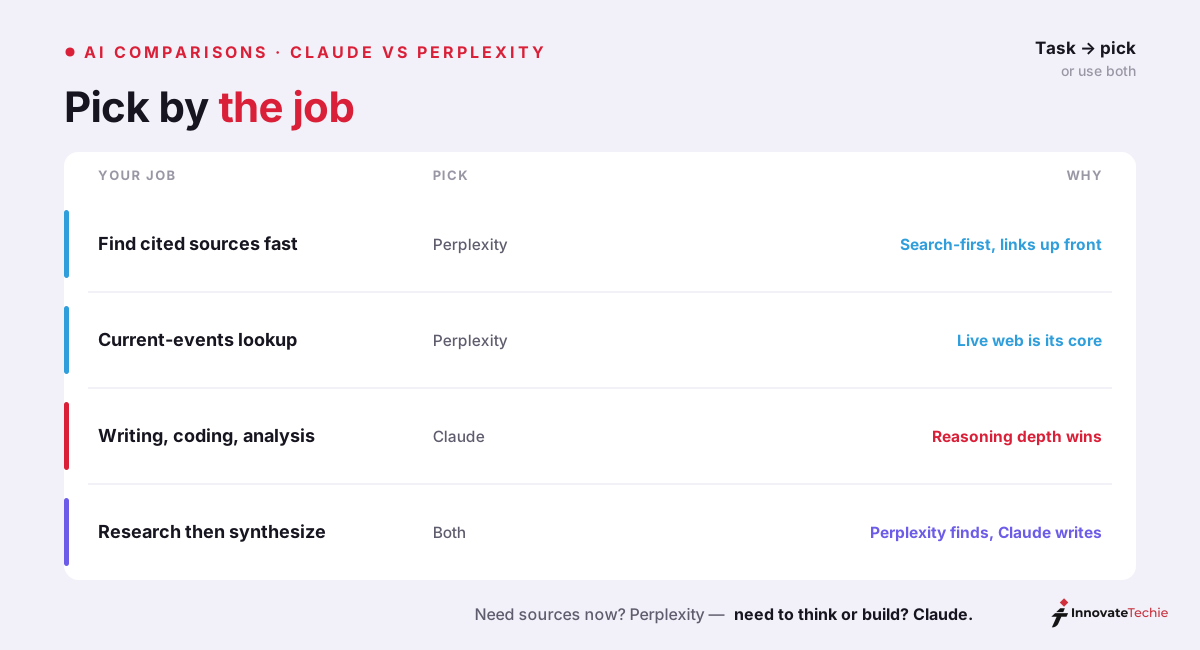
No single winner survives contact with real work, so here's the honest claude vs perplexity call by job:
| Your main task | Better pick | Why |
|---|---|---|
| Breaking news & live facts | Perplexity | Purpose-built live search, sources attached |
| Cited fact-checking | Perplexity | Footnotes every claim by default |
| Deep reasoning & analysis | Claude | Thinks across large inputs, fewer errors |
| Long-form writing | Claude | Coherent past 1,500 words, real tone control |
| Coding & debugging | Claude | Understands whole codebases, runs the code |
| Quick sourced research | Perplexity | Fastest question-to-citations path |
| Synthesizing a position | Claude | Reads sources together, draws conclusions |
| One tool for both | Use both | They fill genuinely different gaps |
The pattern is consistent: Perplexity is the answer engine you open when you need sourced facts in seconds; Claude is the assistant you open when you need to think, build, or write something that has to last. It's the same specialist-versus-generalist split we map across every competitor — including Google's assistant in Claude vs Gemini — and the one that decides most of these matchups.
Using Claude and Perplexity together
The most useful reframe of claude vs perplexity is that it was never really a versus. The professionals who get the most out of both stop choosing and start chaining: Perplexity to discover and gather current, cited information, then Claude to reason over it, structure it, and write it up. Perplexity answers "what's true and where's the source"; Claude answers "what does this mean and what do I do with it."
Here's a concrete loop from our own week. Use Perplexity to pull ten sourced statistics on a topic, paste them into Claude, and ask it to pressure-test the framing, find the throughline, and draft the piece. Perplexity closes the gap Claude has with live data; Claude closes the gap Perplexity has with deep synthesis. Combined, they beat either one alone — which is why "claude vs perplexity" almost always ends in "both."
The quick version:
- Perplexity answers search-first, with citations up front
- Claude reasons deeper for writing, coding, and analysis
- Both paid tiers start at $20/month
- Use Perplexity to find sources, then Claude to build with them
For example, hand both the same research task and a 1,500-word brief: Perplexity returns 8 cited links in seconds, while Claude turns those sources into a finished draft.
Claude pricing at a glance
| Plan | Price |
|---|---|
| Free | $0 |
| Pro | $20 / month |
| Max | from $100 / month |
| API | Pay per token |
For the full breakdown of every plan, see our how much Claude costs guide.
Frequently Asked Questions

Written by
InnovateTechie
Writing about Claude and the Anthropic toolkit — models, Claude Code, pricing, features, and fixes, in clear, practical, hands-on guides tested by daily use.
View all posts →