

Part ofClaude vs Everything: The Complete Claude Comparison
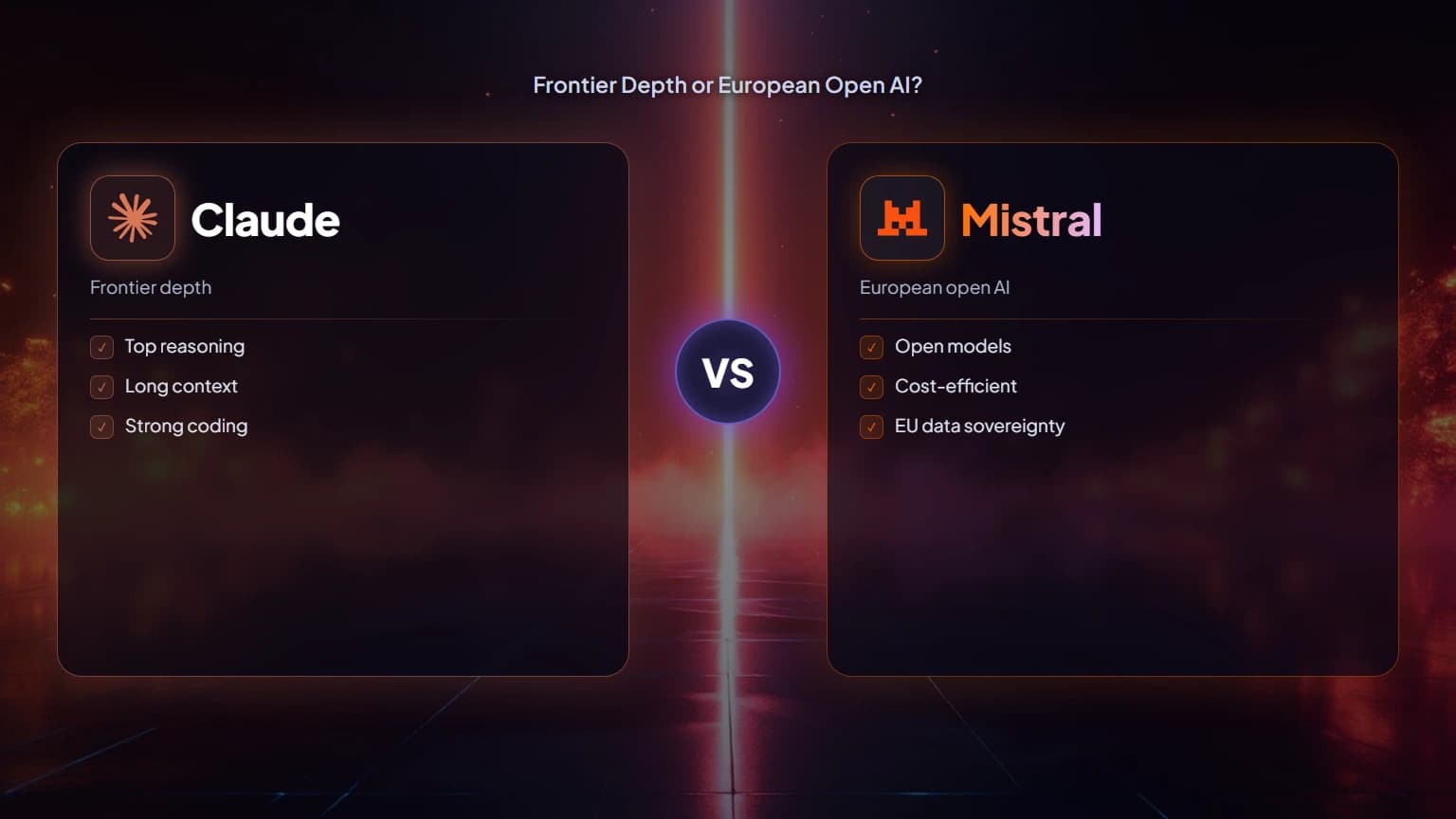
Claude wins on frontier reasoning and coding depth; Mistral wins on open weights, self-hosting, EU data residency, and cost. A task-by-task comparison.
In This Article
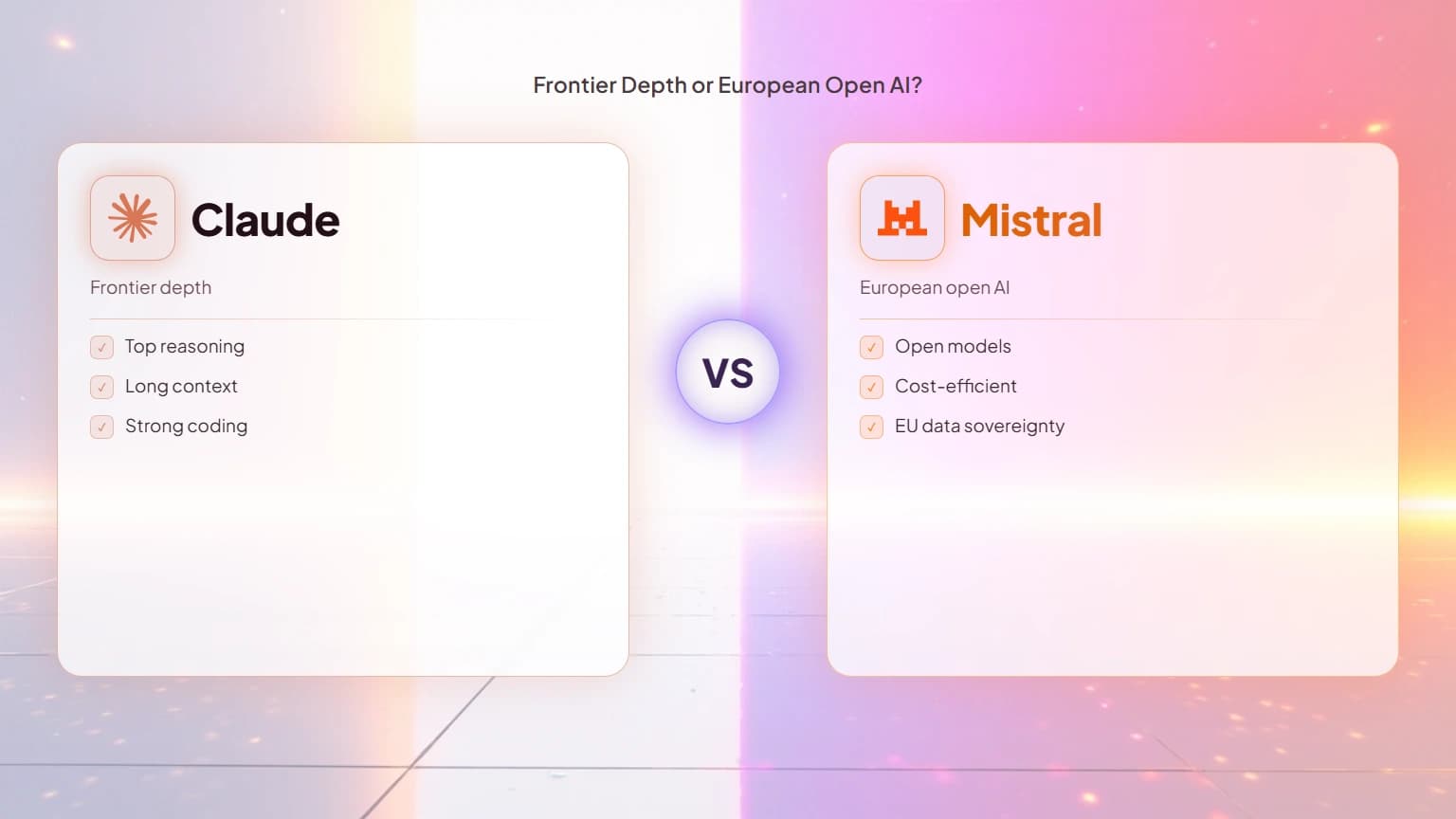
8 sectionsIn the Claude vs Mistral matchup, Claude wins on frontier reasoning, complex coding, and natural writing, while Mistral AI wins on open-weight self-hosting, European data residency, and cost — its API runs roughly ten times cheaper. Neither is universally better: pick Claude for depth, Mistral for openness, privacy, and price.
We run both in production — Claude Code against our own repository, Mistral for cheap high-volume drafting and a self-hosted internal model. This guide is part of our wider Claude comparison hub, and it settles the Claude vs Mistral question task by task rather than crowning a single winner that doesn't survive contact with real work.
Claude vs Mistral: the one-minute verdict
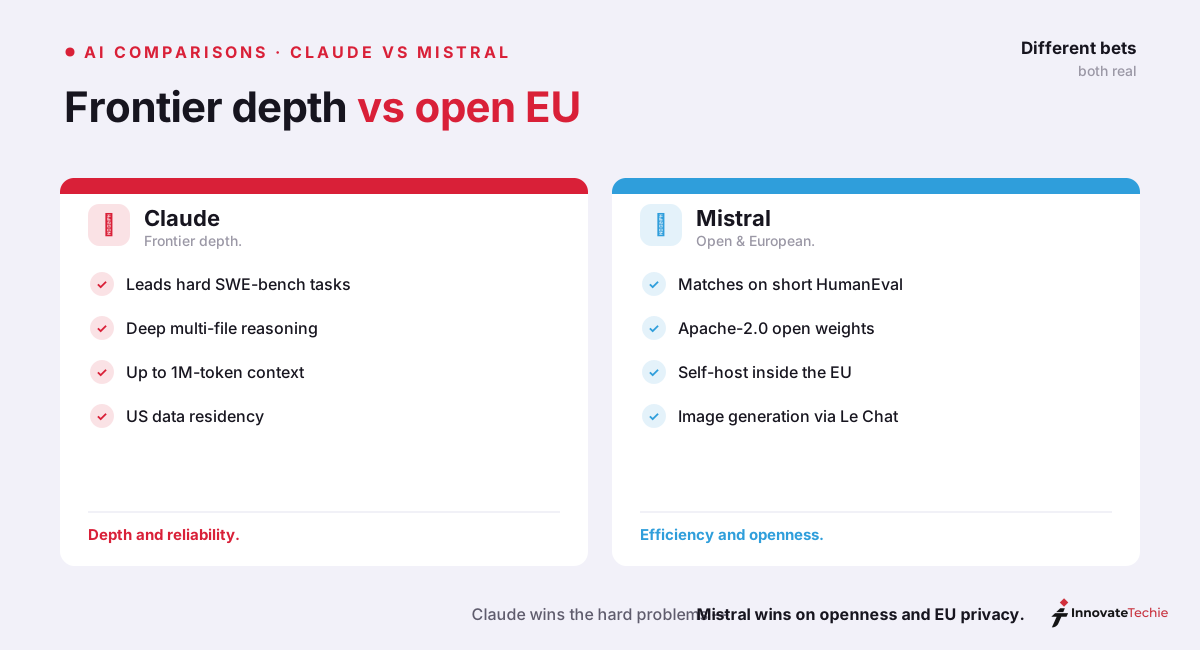
Anthropic and Mistral AI are built around opposite bets. Anthropic tunes Claude for careful, verifiable frontier output and ships it API-only. Mistral, based in Paris, tunes for efficiency and openness — publishing open-weight models you can download, self-host, and run under European data rules. Almost every row below follows from that split.
| Claude (Anthropic) | Mistral (Mistral AI) | |
|---|---|---|
| HQ / jurisdiction | United States | France (EU) |
| Model access | API-only, closed weights | Open-weight + API |
| Flagship models | Opus 4.8, Sonnet 5 | Mistral Large 3, Medium 3.5 |
| Context window | 200K (up to 1M) | Up to 256K |
| Self-hostable | No | Yes — Apache 2.0 models |
| Image generation | No | Yes — via Le Chat |
| Signature strength | Frontier reasoning & coding | Efficiency, openness, EU privacy |
Framed simply, the Claude vs Mistral choice is depth-first versus openness-first. Hand both the same hard, multi-file refactor and Claude produces the cleaner, more reliable diff; hand both a million cheap classification calls and Mistral does it for a fraction of the bill. That trade — quality versus cost and control — is the whole comparison in miniature.
Reasoning and coding depth: Claude's frontier edge
This is where Claude vs Mistral stops being close. On the hardest agentic software-engineering work, Claude leads measurably: Claude Opus 4.8 tops the SWE-bench Pro suite at 69.2%, and Claude scores around 80.9% on SWE-bench Verified — the real-world benchmark that matters when an agent has to change code across many files and keep the diff reviewable.
Mistral is no slouch on code. Mistral Large 3 clears roughly 92% on HumanEval, so for short, self-contained functions the two are effectively tied. The gap opens on complexity. On long, multi-step SWE-bench-style tasks and sustained agentic sessions, Mistral lands in a solid middle tier while Claude stays at the frontier. In our own testing, Claude's edits need fewer correction passes on a large repository.
| Coding dimension | Claude | Mistral |
|---|---|---|
| HumanEval (short problems) | ~90%+ | ~92% |
| SWE-bench Pro (hard, real-world) | 69.2% — leads | Mid-tier |
| Multi-file refactoring | Cleaner, more consistent | Capable, less consistent |
| Agentic coding tool | Claude Code | Le Chat / Mistral Vibe |
The claude vs mistral large comparison at the flagship tier is quality against economy. Mistral Large 3's 256K context lets it read a large program in one shot, and it's genuinely useful for exploration and generation at low cost. But when the job is production-grade change across a repository, Claude Code's reasoning depth is what we trust — a difference we unpack against other rivals in Claude vs Gemini.
Openness and self-hosting: Mistral's structural advantage
Here the balance flips hard. Claude is API-only — there is no Claude model you can download, inspect, or run on your own hardware. Mistral ships a family of genuinely open-weight models: Mistral 7B, the Mixtral mixture-of-experts models, and Mistral NeMo (a 12B model with a 128K context built with NVIDIA), all released under the permissive Apache 2.0 license. You can pull them from Hugging Face, run them with vLLM or Ollama, and fine-tune them on your own data.
For a lot of teams that single fact decides the claude or mistral question before any benchmark. If you need an air-gapped deployment, full control of the weights, or a model that keeps working regardless of a vendor's rate limits and roadmap, Claude simply isn't a candidate and Mistral is. This is the clearest structural win on the board, and it belongs to Mistral.
Privacy, GDPR, and European data residency
The jurisdiction difference is not cosmetic. Anthropic is a US company subject to US law; Mistral is French, processes data inside the EU, and markets itself directly at organizations that need GDPR alignment and data sovereignty. For a European bank, hospital, or public body, that's often a procurement requirement rather than a preference — and it's a requirement Claude, as a US API, can struggle to meet.
Self-hosting compounds the advantage: run an open Mistral model on your own EU infrastructure and your prompts never leave your network at all. Claude counters with strong enterprise controls, SOC 2, and zero-retention API options, which satisfy many compliance regimes. But on the specific axis of European data residency and open self-hosting, mistral ai vs claude is not a close call — Mistral wins it.
Pricing: where Mistral undercuts Claude
Mistral is materially cheaper, and it isn't subtle. Mistral Large 3 runs about $0.50 per million input tokens and $1.50 output; Claude Opus 4.8 runs $5/$25. That's roughly ten times cheaper on input and over fifteen times on output at the flagship tier — you can confirm Anthropic's side on the official Claude pricing page.
| Claude | Mistral | |
|---|---|---|
| Free tier | Yes — tight caps | Le Chat Free (~25 msgs/day) |
| Entry paid plan | Pro $20/mo | Le Chat Pro $14.99/mo |
| Flagship API price | Opus 4.8 — $5/$25 per M | Large 3 — $0.50/$1.50 per M |
| Cheapest API model | Haiku 4.5 — $1/$5 per M | Small — ~$0.20 per M |
| Open weights to self-host | None | 7B, Mixtral, NeMo (Apache 2.0) |
Both offer a free way to test. Mistral's Le Chat Free gives real access to its frontier models, image generation, and a code interpreter, soft-capped around 25 messages a day; Claude's free tier gives basic chat with tighter limits. On paid plans Le Chat Pro is $14.99/month against Claude Pro's $20. For high-volume, low-stakes work — bulk classification, summarization at scale — Mistral's per-token price is decisive, a gap we put in context in our Claude API pricing breakdown.
Writing, languages, and context
For English long-form prose, Claude is the stronger writer — more human-sounding and nuanced, and it holds voice and structure across an extended draft where Mistral drifts toward a flatter default. That mirrors what we find across every comparison in our hub. Mistral's counter is multilingual reach: it handles French, German, Spanish, and Italian with real fluency, which makes it a better default for European-language content at volume.
On context, the picture is closer than the old numbers suggest. Mistral Large 3's 256K window actually edges Claude's 200K default, though Claude's optional 1M-token window is the largest ceiling of the two — worth it only for whole-corpus jobs, as we explain in our context window guide. For most work, both hold a large codebase or document set comfortably.
The task-by-task verdict
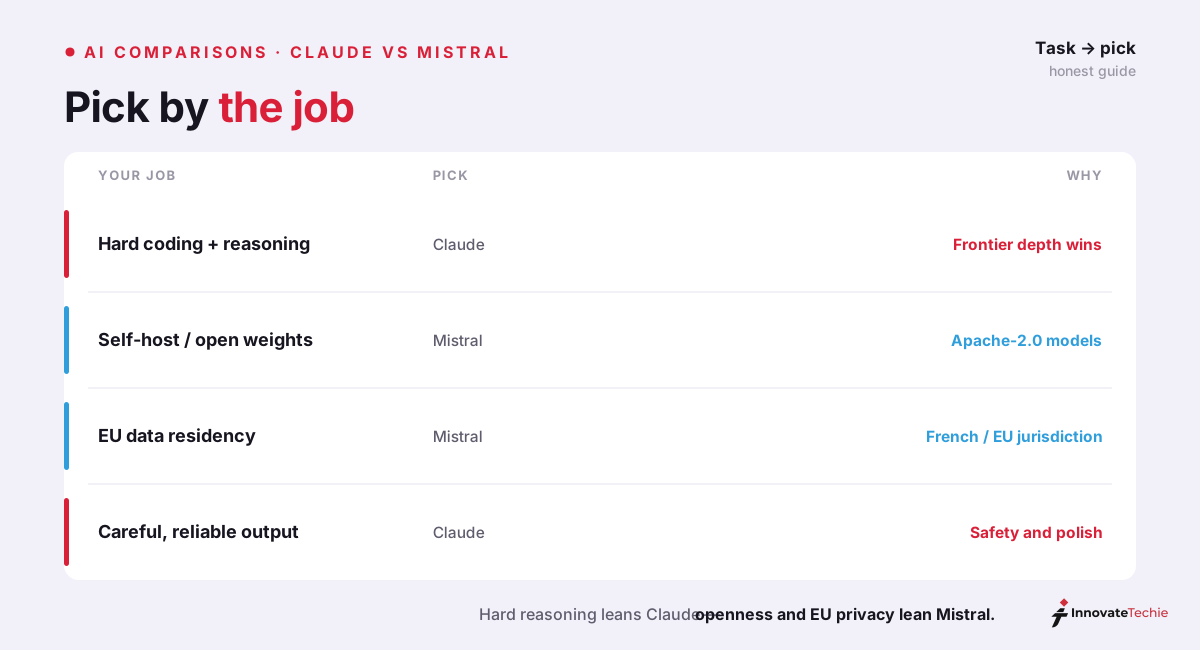
No single winner survives real work, so here's the honest call by use case. This is the table we'd hand a team choosing between them.
| Your main task | Better pick | Why |
|---|---|---|
| Complex production coding | Claude | Higher on hard SWE-bench, cleaner multi-file diffs |
| Cheap, high-volume API calls | Mistral | Roughly 10x cheaper per token |
| Self-hosted / on-prem AI | Mistral | Apache 2.0 open weights you control |
| EU data residency & GDPR | Mistral | Paris-based, EU data processing |
| Natural long-form writing | Claude | More nuanced, holds voice over drafts |
| European-language content | Mistral | Strong French, German, Spanish, Italian |
| Careful reasoning & judgment | Claude | Fewer confident errors |
| Reasoning-heavy AI agents | Claude | Deeper tool-use and multi-step reasoning |
| Budget or low-stakes tasks | Mistral | Free Le Chat plus cheap API |
The pattern: Claude is the frontier specialist you pick when the quality of one output — code, a decision, a draft — is expensive to get wrong. Mistral is the efficient, open, European alternative you pick when cost, control, or data residency outweigh a marginal quality edge. Plenty of teams run both and route by task, exactly as they do with the cheaper open-ish rivals we cover in Claude vs DeepSeek.
The quick version:
- Claude leads reasoning, hard coding, and English writing
- Mistral leads on price, open weights, self-hosting, and EU privacy
- Claude is API-only; Mistral you can download and run yourself
- Both have a free tier — test each on one real task before committing
For example, on 1 hard multi-file bug Claude reasoned to a fix in a single pass, while a self-hosted Mistral model kept the data in the EU at roughly a third of the API cost.
Claude pricing at a glance
| Plan | Price |
|---|---|
| Free | $0 |
| Pro | $20 / month |
| Max | from $100 / month |
| API | Pay per token |
For the full breakdown of every plan, see our how much Claude costs guide.
Frequently Asked Questions

Written by
InnovateTechie
Writing about Claude and the Anthropic toolkit — models, Claude Code, pricing, features, and fixes, in clear, practical, hands-on guides tested by daily use.
View all posts →