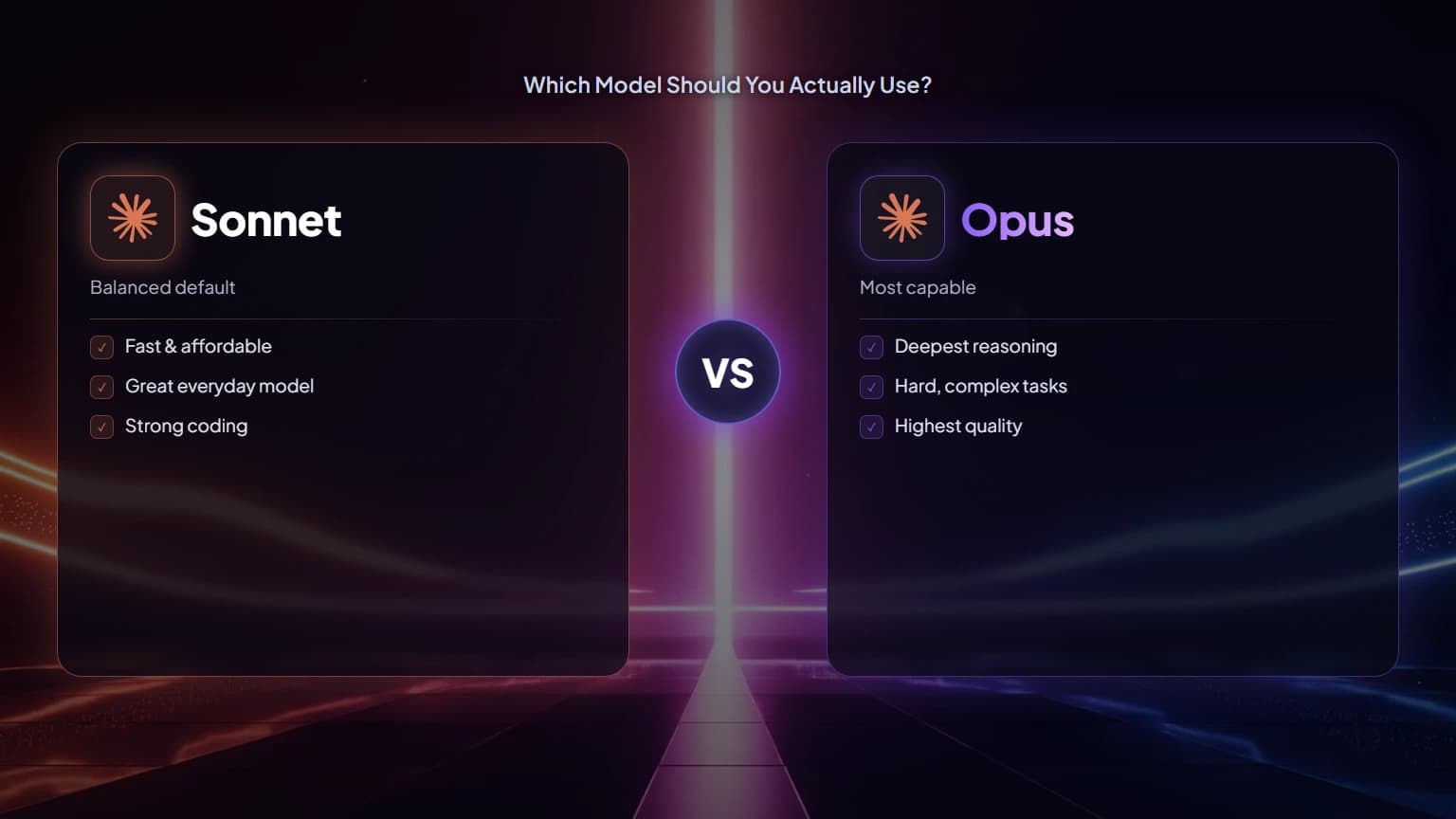




Part ofClaude Models Explained: Opus vs Sonnet vs Haiku
Claude Sonnet 5 is Anthropic's balanced daily-driver model — near-Opus performance at $3/$15, a 1M-token context window, and adaptive thinking on by default.
In This Article
7 sectionsClaude Sonnet 5 is Anthropic's balanced daily-driver model, released June 30 as a drop-in upgrade to Sonnet 4.6. It pairs near-Opus 4.8 reasoning with lower cost — $3 per million input tokens and $15 per million output — a 1M-token context window, and adaptive thinking on by default. It's the default model on Claude's Free and Pro plans.
We've spent the past week running Sonnet 5 as our default model for everything from bug hunts to drafting these very posts, and the short version of this Claude Sonnet 5 review is simple: it's the model most people should reach for first. Opus 4.8 is still the heavyweight and Haiku 4.5 is still the cheap sprinter, but Sonnet 5 is the one that quietly handles 80% of the work. Here's where it fits, what it costs, and when to reach for something else. For the full lineup, our Claude models explained pillar maps every tier.
What is Claude Sonnet 5?
Claude Sonnet 5 is the newest model in Anthropic's mid-tier Sonnet family, released June 30 as a drop-in upgrade to Sonnet 4.6. Anthropic pitches it as its most agentic Sonnet yet: it plans multi-step work, then uses tools — browsers, terminals, file systems — to finish the job on its own, at close to Opus 4.8 quality for a fraction of the price. That "finish the job, don't just answer the question" framing is the whole point, and it's laid out in Anthropic's launch announcement.
Three things changed under the hood versus Sonnet 4.6, and they matter more than the version bump suggests. Adaptive thinking is now on by default, so the model decides how long to reason instead of waiting for you to flip a switch — an evolution of Claude's extended thinking. Manual extended thinking is gone: set a thinking budget and the API returns a 400 error. And sampling parameters (temperature, top_p, top_k) no longer accept non-default values. If you're migrating code, those are the three lines to check.
Claude Sonnet 5 pricing: the introductory window
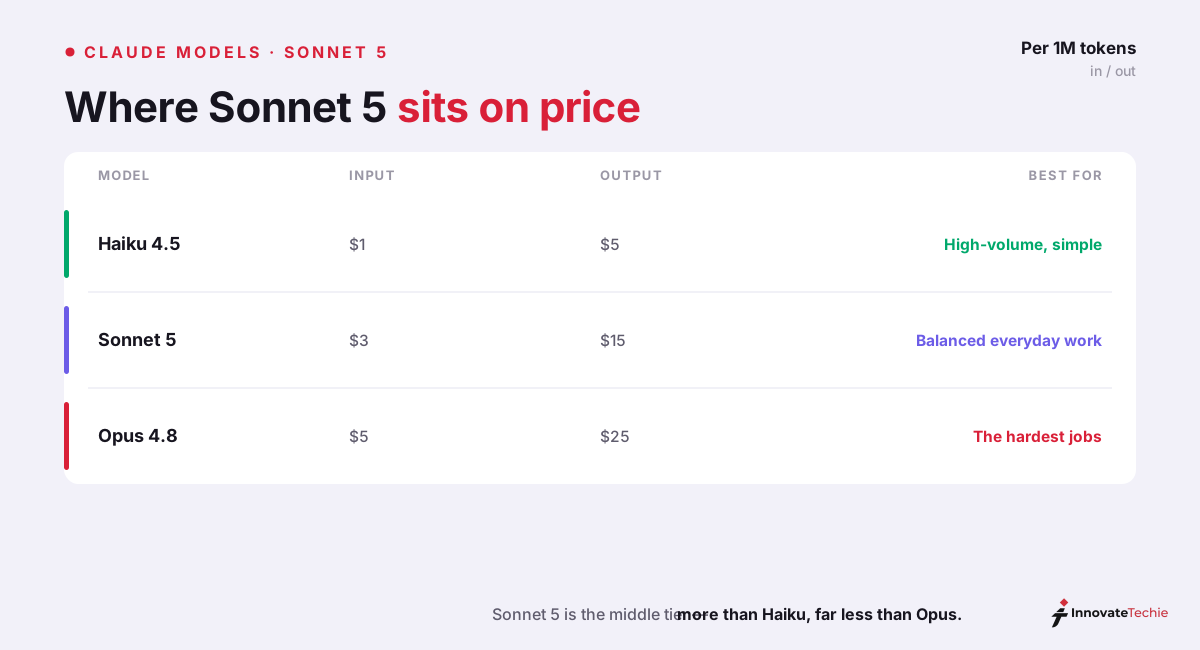
Pricing is where the model gets genuinely interesting. Standard pricing is $3 per million input tokens and $15 per million output tokens — identical to Sonnet 4.6. But through August 31, Anthropic is running introductory pricing of $2 per million input and $10 per million output, which makes Sonnet 5 temporarily cheaper than the model it replaces while being noticeably smarter.
Here's how it sits against the rest of the current lineup:
| Model | Input / 1M | Output / 1M | Best for |
|---|---|---|---|
| Haiku 4.5 | $1 | $5 | High-volume, latency-sensitive tasks |
| Sonnet 5 (intro) | $2 | $10 | The everyday default — through Aug 31 |
| Sonnet 5 (standard) | $3 | $15 | Balanced coding, writing, agentic work |
| Sonnet 4.6 | $3 | $15 | The model Sonnet 5 replaces |
| Opus 4.8 | $5 | $25 | The hardest reasoning and agentic jobs |
On the consumer side, none of this touches you directly: Sonnet 5 is the default model on the Free and Pro plans, so a $20-per-month Claude Pro plan gets you the model with generous limits and no per-token math. Per-token pricing only applies through the API. If you're comparing tiers on price, our Anthropic Claude API pricing breakdown has the batch and prompt-caching rates too.
Speed and cost vs. Opus 4.8
The question we get most is whether Sonnet 5 makes Opus 4.8 redundant. It doesn't — but it narrows the gap enough that the default should flip. On many agentic and coding tasks, Sonnet 5 now approaches Opus 4.8's quality at roughly half the cost and higher throughput. Opus 4.8 still leads on the genuinely hard problems: it posts a 69.2% score on SWE-bench Pro, the toughest agentic coding benchmark, and pulls ahead when a task needs deep multi-step reasoning that can't survive a single wrong turn.
The way we think about it: run Sonnet 5 by default, and escalate to Opus 4.8 only when Sonnet visibly struggles — a refactor it can't hold in its head, a proof it keeps botching. For a deeper split, we compared them head-to-head in Claude Sonnet vs Opus.
| Sonnet 5 | Opus 4.8 | |
|---|---|---|
| Positioning | Balanced daily-driver | Maximum capability |
| API price (standard) | $3 / $15 per 1M | $5 / $25 per 1M |
| Relative speed | Faster, higher throughput | Slower, more deliberate |
| Best at | Everyday coding, writing, tool use | Hardest reasoning + agentic jobs |
| SWE-bench Pro | Approaches Opus | 69.2% |
Everyday coding and writing with Claude Sonnet 5
Most of what we ship runs on Sonnet 5, and the two workloads it handles best are exactly the ones most people have: writing code and writing prose.
For coding, the agentic upgrades show. Point Claude Code at a repo and Sonnet 5 will read files, run the test suite, and iterate on a fix without you narrating each step — the finish-the-job behavior Anthropic tuned for. It's the model we leave selected in the terminal for routine feature work, reserving Opus 4.8 for the gnarly stuff.
For writing, the near-Opus reasoning means drafts need less cleanup. Sonnet 5 holds a brief, keeps a consistent voice across a long document, and follows structural instructions ("lead with the answer, then three examples") more reliably than 4.6 did. It won't generate images — Claude is a text and code model, full stop — but for the words themselves it's the best value in the lineup.
The 1M-token context window and the new tokenizer
Claude Sonnet 5 ships with a 1M-token context window by default — enough to hold a mid-size codebase or a stack of long documents in a single prompt. There's no smaller-context variant to choose; 1M is both the default and the maximum. If you want the mechanics of how that much context behaves in practice, we cover it in Claude's context window.
There's one gotcha worth flagging, because it trips up developers migrating from 4.6: Sonnet 5 uses a new tokenizer, and the same text produces roughly 30% more tokens than before. Nothing about the API shape changes, but three things you budget in tokens do. Your max_tokens limit, tuned for 4.6, may now truncate equivalent output. Your context window holds less actual text than the raw 1M suggests. And a request's cost can rise even though the per-token price didn't. Anthropic documents the exact behavior in the Sonnet 5 release notes; the fix is simply to recount your prompts against the new model rather than reuse old numbers.
When Claude Sonnet 5 is the right pick
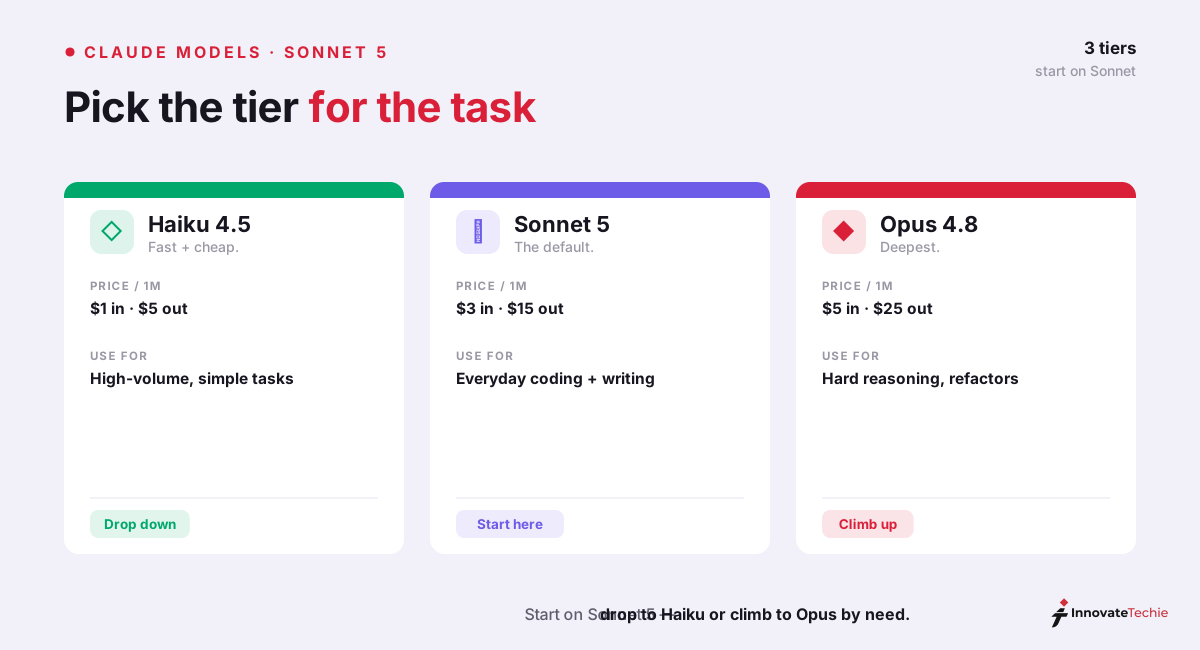
Pick Sonnet 5 as your default and only deviate for a reason. Here's the decision we actually use:
| Your situation | Reach for |
|---|---|
| Everyday coding, drafting, tool use, most agentic work | Sonnet 5 |
| The hardest reasoning, high-stakes refactors, deepest agentic runs | Opus 4.8 |
| High-volume, latency-sensitive, cost-capped tasks | Haiku 4.5 |
| On Free or Pro, not touching the API | Sonnet 5 (it's the default) |
If you're weighing the cheaper tier, Claude Haiku vs Sonnet walks through where Haiku's speed wins and where it falls short. The honest summary: Sonnet 5 is the model you should have selected unless you have a specific reason not to. It's fast enough to feel responsive, cheap enough to run all day, and smart enough that reaching for Opus 4.8 becomes the exception rather than the habit.
The quick version:
- The balanced daily-driver for coding and writing
- Costs $3 in / $15 out ($2/$10 intro) per million
- Faster and cheaper than Opus 4.8
- Start here; escalate to Opus only when needed
Claude pricing at a glance
| Plan | Price |
|---|---|
| Free | $0 |
| Pro | $20 / month |
| Max | from $100 / month |
| API | Pay per token |
For the full breakdown of every plan, see our how much Claude costs guide.
Frequently Asked Questions

Written by
InnovateTechie
Writing about Claude and the Anthropic toolkit — models, Claude Code, pricing, features, and fixes, in clear, practical, hands-on guides tested by daily use.
View all posts →