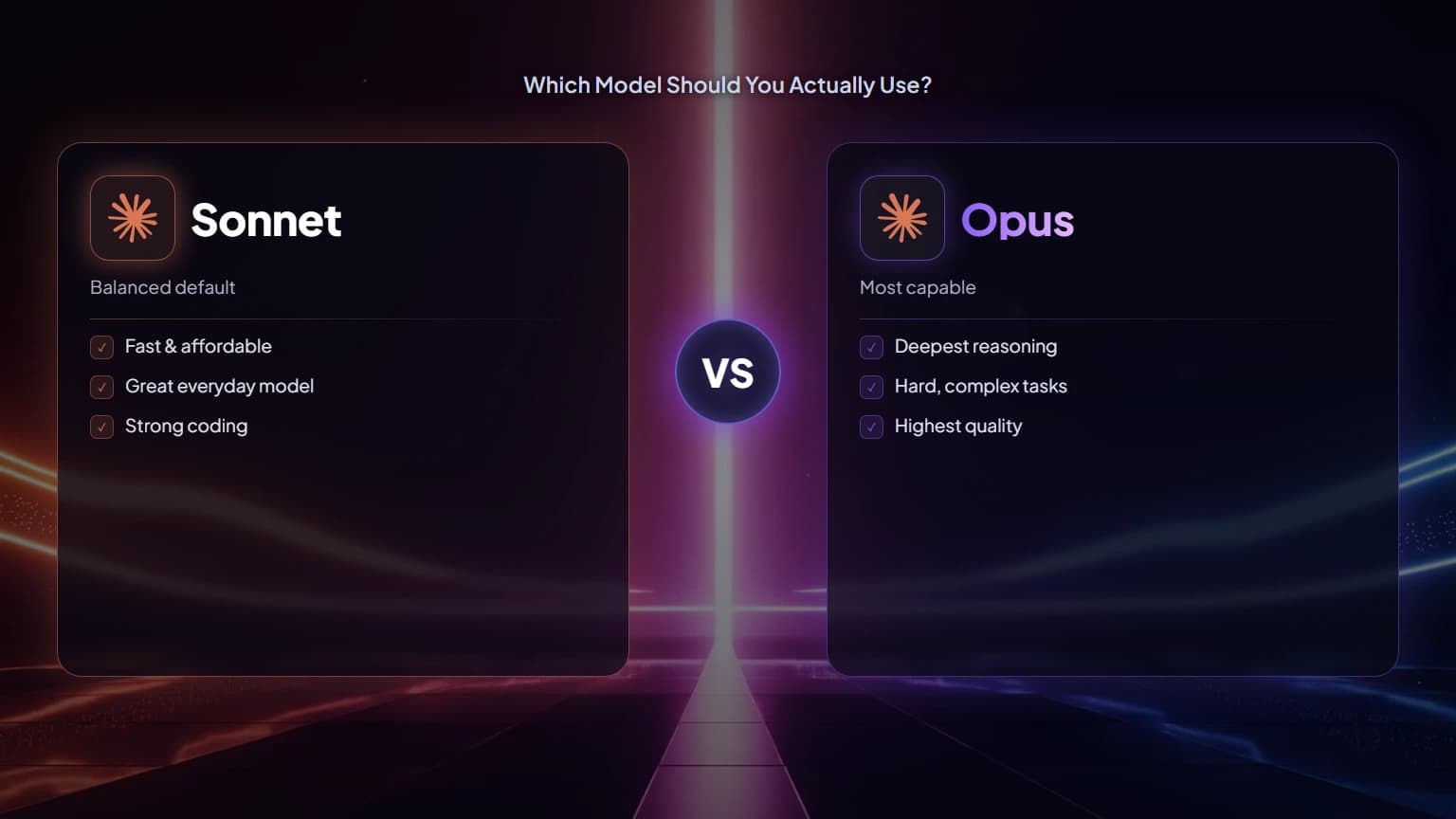


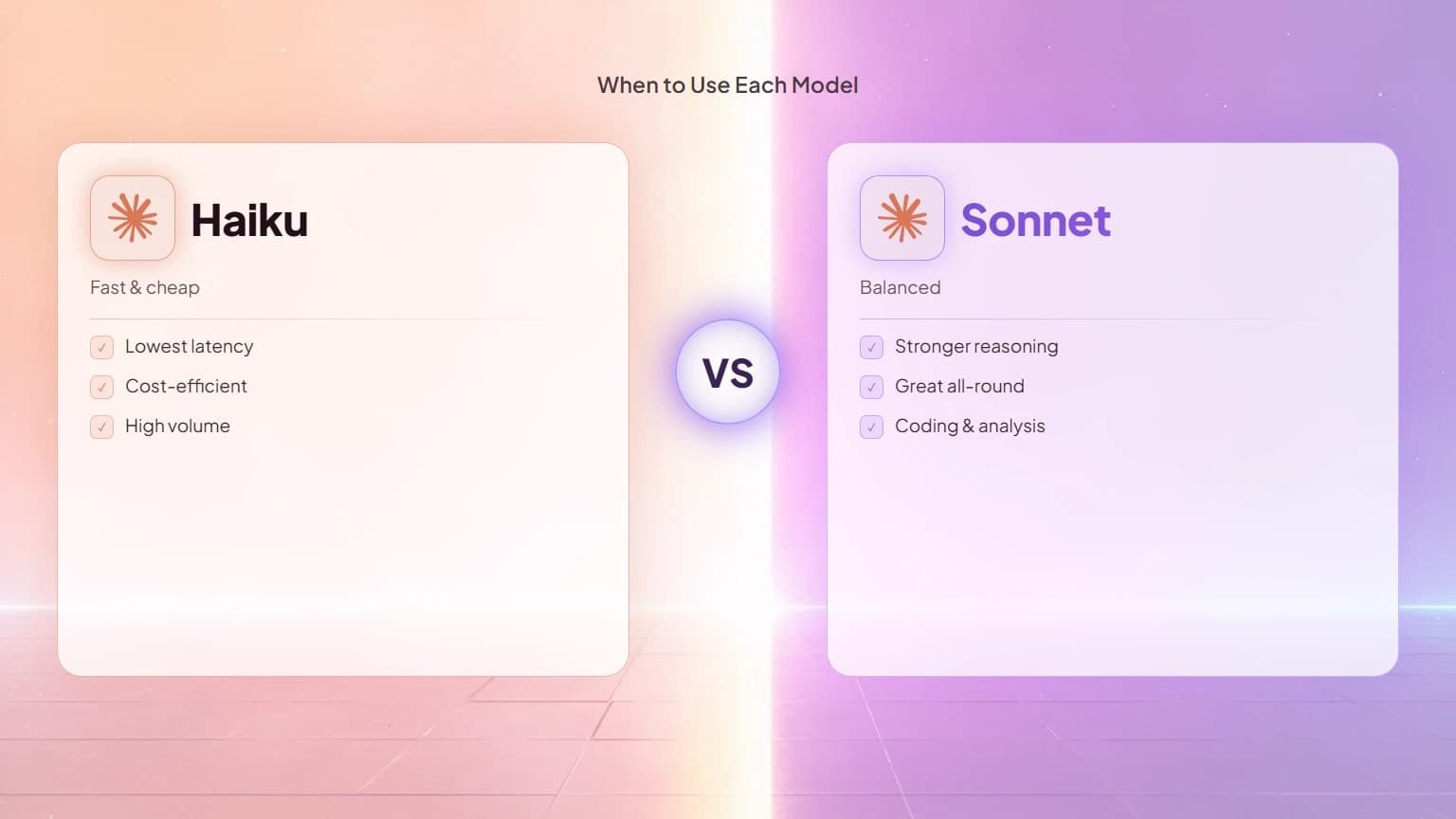
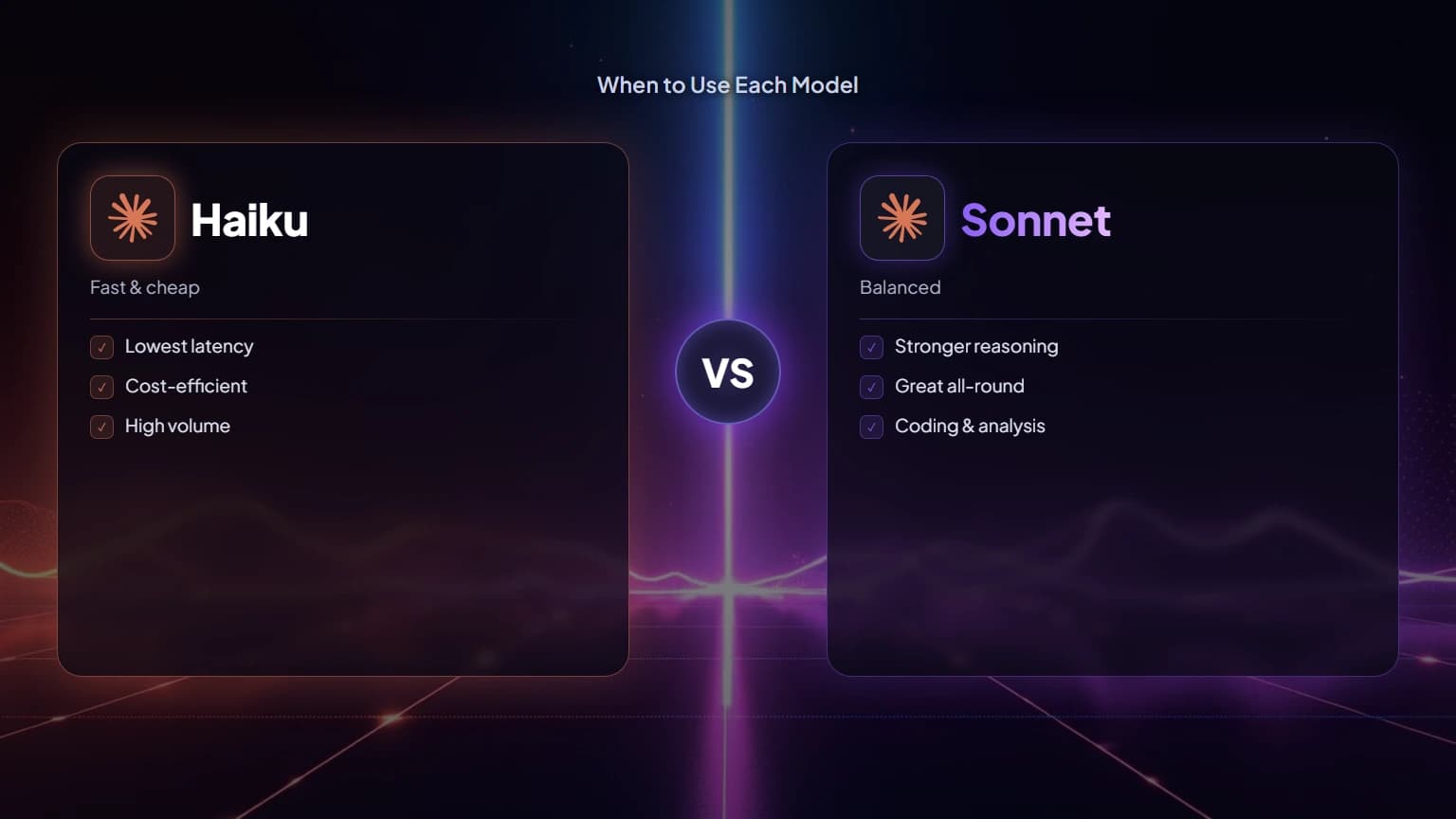
Part ofClaude Models Explained: Opus vs Sonnet vs Haiku
Claude Haiku vs Sonnet: Haiku is cheaper and faster ($1/$5, 200K context), Sonnet is stronger ($3/$15, 1M). When each model is the right call.
In This Article
8 sectionsIn the Claude Haiku vs Sonnet decision, Haiku 4.5 ($1/$5 per million tokens) is the fast, cheap choice for classification, extraction, and high-volume work, while Claude Sonnet 4.6 and Sonnet 5 ($3/$15) cost roughly 3x more but reason far better for coding, writing, and multi-step analysis. Default to Sonnet, and drop to Haiku when speed and price outweigh depth.
We route real production traffic across both tiers every day on this site, so the Claude Haiku vs Sonnet question isn't abstract for us — it sets our monthly bill and our response times. The Haiku vs Sonnet Claude debate reduces to a single trade-off: raw throughput against reasoning depth. Below we break down the speed gap, the price gap, the quality gap, the context-window difference, and a decision guide you can apply per task rather than per project. For the full lineup around these two tiers, our pillar guide to every Claude model sets the wider context.
Claude Haiku vs Sonnet at a glance
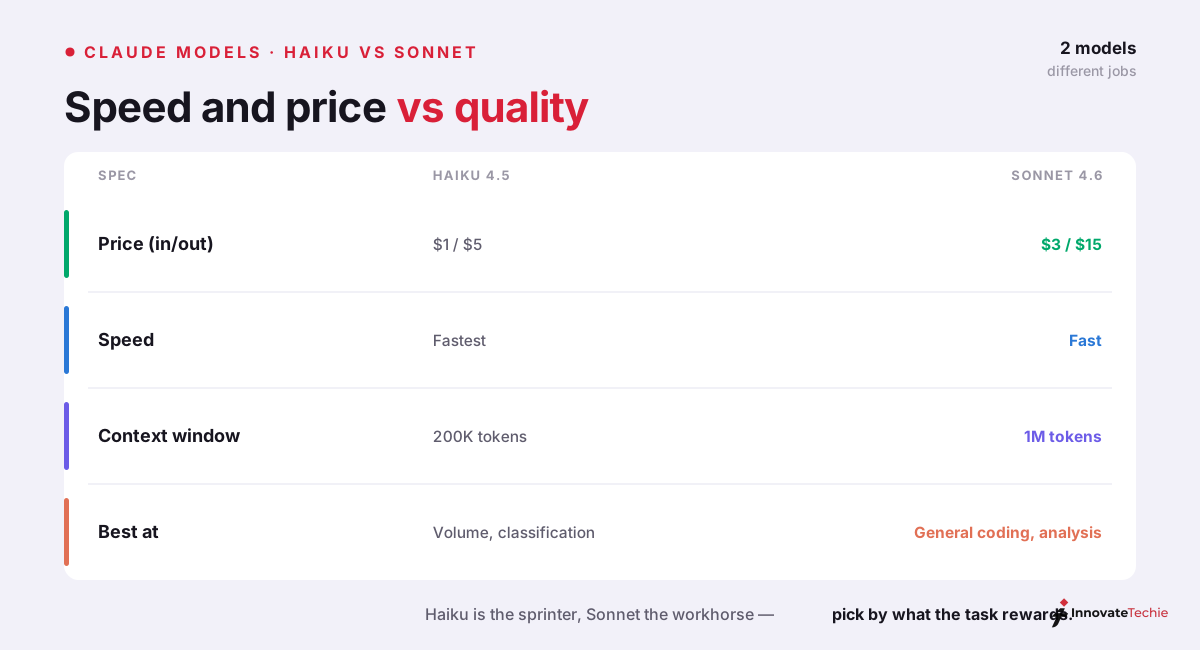
The Claude Haiku vs Sonnet comparison starts with the raw specifications, and the two tiers diverge on price, context, and output ceiling more than on anything else. Here are the published model specifications side by side.
| Claude Haiku 4.5 | Claude Sonnet 4.6 | Claude Sonnet 5 | |
|---|---|---|---|
| Role | Speed and volume | Balanced default | Newest balanced default |
| API price (in/out per MTok) | $1 / $5 | $3 / $15 | $3 / $15 (intro $2 / $10 through Aug 31) |
| Context window | 200K tokens | 1M tokens | 1M tokens |
| Max output | 64K tokens | 128K tokens | 128K tokens |
| Relative speed | Fastest | Fast | Fast |
| Best for | Classification, extraction, routing | Coding, writing, analysis | Coding, agents, hardest Sonnet-tier work |
A quick read of that table: Haiku is one-third the price with a fifth of the context, and the two Sonnet versions share the same $3/$15 rate. So the practical choice is almost always Haiku versus a Sonnet — not Sonnet 5 versus Sonnet 4.6. Sonnet 5's introductory pricing ($2/$10 through August 31) temporarily halves the gap to Haiku, but the standard rate is what you should plan around.
Claude Haiku vs Sonnet speed: the throughput gap
Speed is Haiku's headline feature. Claude Haiku 4.5 runs roughly 3x faster than Sonnet on simple prompts and 4-5x faster on typical production workloads, and it returns responses in under 200 milliseconds for short inputs. Anthropic positions Haiku 4.5 as near-frontier intelligence at a fraction of the latency and cost, and in our own pipelines the difference is obvious the moment volume climbs.
Latency is multiplicative at scale, which is why the gap matters far more than it looks on a single call. A tagging job over a million records that takes 800 milliseconds each on a Sonnet drops to well under 300 milliseconds on Haiku — that is hours saved across the batch, not seconds. For real-time chat, autocomplete, content moderation, and anything a user actively waits on, that throughput is the difference between an interface that feels instant and one that stalls.
Cost: the cheapest Claude model
Claude Haiku 4.5 is the cheapest Claude model in the current lineup, at $1 per million input tokens and $5 per million output — exactly one-third of Sonnet's $3/$15. On the Claude Haiku vs Sonnet cost question, the math stays clean: because Sonnet prices both input and output at precisely 3x Haiku, an identical workload costs a Sonnet three times what Haiku charges. Here is a concrete example, processing 10 million input tokens and generating 2 million output tokens:
| Model | 10M input tokens | 2M output tokens | Total |
|---|---|---|---|
| Claude Haiku 4.5 | $10 | $10 | $20 |
| Claude Sonnet 4.6 / 5 (standard) | $30 | $30 | $60 |
| Claude Sonnet 5 (intro) | $20 | $20 | $40 |
That $40 difference is trivial on one request and decisive across millions. During Sonnet 5's introductory window the gap narrows to 2x, but once standard pricing resumes it returns to a flat 3x. When a workload is genuinely high-volume and the per-record quality difference is small, Haiku is the obvious pick — and for the complete rate card, including batch and prompt-caching discounts, see our Claude API pricing guide.
The quality gap: where Sonnet's reasoning wins
Price and speed both favor Haiku, so why not run it everywhere? Because the two tiers are not the same intelligence. Claude Sonnet 4.6 and Sonnet 5 reason through multi-step problems, hold far more of a codebase in working memory, catch subtle logic errors, and follow long instructions that Haiku tends to flatten. In every Claude Haiku vs Sonnet benchmark that stresses multi-step reasoning, math, or code understanding, Sonnet pulls clearly ahead — and the gap widens as the task gets harder.
The useful nuance is that the reasoning gap only appears on reasoning-heavy work. For classification, extraction, formatting, and routing — tasks with clear inputs and clear outputs — Haiku stays within a few points of Sonnet's accuracy, because those jobs never exercise the gap in the first place. That single insight is the whole game: match the model to whether the real bottleneck is depth or throughput. This benchmark-style breakdown maps common tasks to the tier that wins:
| Task | Claude Haiku 4.5 | Claude Sonnet 4.6 / 5 | Winner |
|---|---|---|---|
| Classification & tagging | Near-parity accuracy | Slight edge | Haiku — speed + cost |
| Data extraction | Near-parity accuracy | Slight edge | Haiku |
| Real-time chat & support | Under 200 ms responses | Slower | Haiku |
| Everyday coding | Good on small snippets | Strong on full features | Sonnet |
| Large-codebase reasoning | Capped by 200K context | 1M context, deep reasoning | Sonnet |
| Multi-step analysis & math | Capable | Much stronger | Sonnet |
Context windows and when 1M tokens matters
One spec quietly decides some projects on its own: Claude Haiku 4.5 has a 200,000-token context window, while Claude Sonnet 4.6 and Sonnet 5 each offer 1,000,000 tokens — five times larger. For short prompts the difference is invisible. But feed a model an entire repository, a book-length document, or a long multi-turn agent transcript, and Haiku runs out of room exactly where Sonnet keeps going. If a task must reason over more than roughly 150,000 tokens at once, the choice is already made for you — it is Sonnet, regardless of speed or price.
When to use Claude Haiku (and when Sonnet's quality is worth 3x)
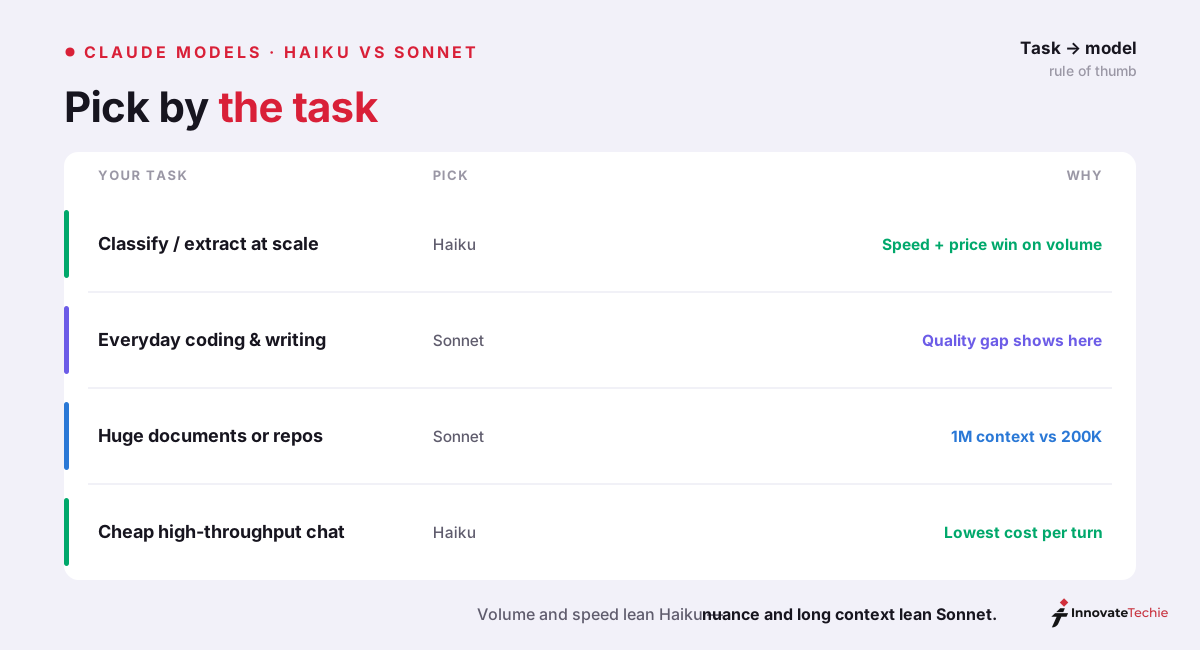
Our routing rule is simple. Send to Claude Haiku 4.5 anything high-volume, latency-sensitive, and well-specified: classification, tagging, extraction, formatting, routing, summarization, and real-time chat or support. These are the jobs where the speed and the one-third price win outright, and where Haiku's accuracy sits within a rounding error of Sonnet's.
Reach for Claude Sonnet — 4.6 or 5 — when quality is the constraint: coding beyond small snippets, large-codebase work, subtle debugging, long-form writing, multi-step analysis, and agents that chain many tool calls. Here the reasoning depth is genuinely worth paying 3x for, because a wrong answer costs more than the token difference ever will. Whether you need Claude Sonnet or Haiku, the honest default is Sonnet first and Haiku as the deliberate optimization once you have measured a task and know it is safe to drop down.
How to choose: a Claude Haiku vs Sonnet decision guide
The Claude Haiku vs Sonnet decision is best made per task, not locked in per project — many teams route each request automatically based on its complexity. Use this guide as a starting point:
| If your task is… | Use | Why |
|---|---|---|
| High-volume, simple, latency-sensitive | Claude Haiku 4.5 | ~3x faster, one-third the cost |
| Coding, writing, analysis, agents | Claude Sonnet 4.6 / 5 | Reasoning depth worth the 3x price |
| Over ~150K tokens of context | Claude Sonnet 4.6 / 5 | Haiku's 200K window runs out |
| Unsure | Start with Sonnet | Handles most work; drop to Haiku after measuring |
If you're comparing Claude against other assistants entirely, or want to know what Claude costs across plans, those guides go a level up. And when even Sonnet's reasoning falls short on the hardest refactors or research, that is the moment to read Claude Sonnet vs Opus — the next escalation up the ladder. The pattern that actually controls cost and quality is not picking one model forever; it is the habit of asking, task by task, whether this job needs Sonnet's reasoning or just Haiku's speed.
The quick version:
- Haiku 4.5 costs $1/$5 per MTok; Sonnet 4.6 costs $3/$15
- Haiku is fastest; Sonnet is stronger on nuance
- Haiku holds 200K tokens; Sonnet holds 1M
- Volume work leans Haiku; quality work leans Sonnet
For example, on a batch of 10,000 support tickets to classify, Haiku 4.5 finishes for roughly a third of Sonnet's cost — and the accuracy gap is invisible on a task that simple.
Claude pricing at a glance
| Plan | Price |
|---|---|
| Free | $0 |
| Pro | $20 / month |
| Max | from $100 / month |
| API | Pay per token |
For the full breakdown of every plan, see our how much Claude costs guide.
Frequently Asked Questions

Written by
InnovateTechie
Writing about Claude and the Anthropic toolkit — models, Claude Code, pricing, features, and fixes, in clear, practical, hands-on guides tested by daily use.
View all posts →