




Part ofClaude AI Features: The Complete Overview
Claude extended thinking lets the model reason step by step before answering. When reasoning mode helps, how to trigger it, and the cost and latency trade-off.
In This Article
7 sectionsClaude extended thinking is a mode where the same model reasons step by step in a visible scratchpad before it answers, spending extra time and tokens on hard problems. Turn it on for math, multi-step logic, and complex debugging; skip it for lookups and simple writing, where it only adds cost and latency without improving the result.
We've run Claude extended thinking against real work on this site for months — refactors, tricky SQL, editorial fact-checks — and the pattern is consistent: it earns its keep on a narrow set of genuinely hard tasks and wastes money on everything else. This guide covers what the mode is, how it works under the hood, when it pays off, how to switch it on, and the exact cost you take on when you do.
What is Claude extended thinking?
Claude extended thinking is Anthropic's reasoning mode: instead of replying immediately, Claude spends more time breaking a problem down, planning an approach, and exploring options in a visible thinking block before it commits to a final answer. Anthropic introduced the feature with visible extended thinking, and the key word is visible — you can expand the reasoning and read a summary of how Claude got there.
If you've done any prompt engineering, this will feel familiar. Claude extended thinking is chain-of-thought reasoning built into the model rather than coaxed out with a "think step by step" instruction. The old trick — asking the model to show its work in the prompt — still helps in standard mode, and we cover it in our Claude prompt engineering guide. Extended thinking makes that behavior a first-class setting with its own token budget, so you don't have to engineer it every time.
One point matters above the rest: this is the same model. Claude reasoning mode is not a separate, smarter Claude that gets swapped in — it's Opus or Sonnet given permission to think longer before answering.
How Claude extended thinking actually works
Under the hood, extended thinking splits Claude's response into two parts. First comes a thinking content block — a scratchpad where the model works through the problem in sequential steps. Then comes the text block: the polished answer you actually asked for. Anthropic's extended thinking documentation describes this as giving the model more serial test-time compute — more sequential reasoning steps applied to a single request.
That phrase, serial test-time compute, is the whole idea. A normal completion does one forward pass and streams the answer. Extended thinking lets the model loop: draft a plan, test it against the constraints, catch its own mistake, revise, and only then answer. On a logic puzzle or a subtle bug, that self-correction is exactly what separates a right answer from a confident wrong one.
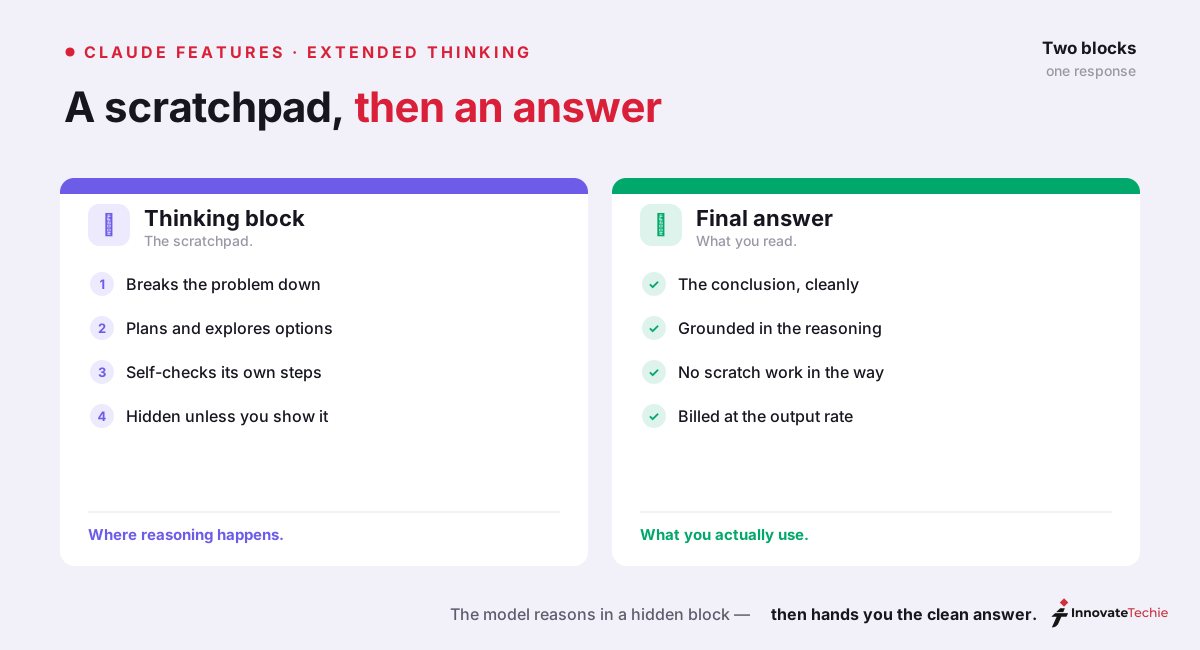
You don't see the raw thinking tokens. In Claude.ai an expandable "Thinking" section shows a readable summary of the reasoning; through the API, thinking content blocks return summarized thinking text ahead of the answer. You're billed for the full reasoning even though you only read the summary — a detail that matters for cost, which we'll get to.
When Claude extended thinking helps (and when it doesn't)
The single most useful thing to internalize about claude thinking mode is that its benefit is task-shaped, not universal. On problems with a single correct answer reached through several dependent steps, extended reasoning measurably improves accuracy. On lookups, extraction, and formatting, it produces the same output a normal call would — just slower and pricier.
Here's how we decide, task by task:
| Task type | Extended thinking? | Why |
|---|---|---|
| Math and quantitative reasoning | Yes | Multi-step arithmetic and proofs benefit from self-checking |
| Debugging and code review | Yes | The model traces logic, forms a hypothesis, and tests it |
| Logic puzzles and constraint problems | Yes | Backtracking across constraints needs serial reasoning |
| Complex multi-step analysis | Yes | Planning before answering keeps long chains coherent |
| Factual lookup or definition | No | One-pass recall; thinking adds nothing but latency |
| Summarization and extraction | No | Output is comparable at a fraction of the cost |
| Format conversion and classification | No | Deterministic transforms don't need deliberation |
| General writing and email | No | Fluency doesn't improve with a longer scratchpad |
The rule of thumb: if a competent human would need scratch paper, turn extended thinking claude on. If they'd answer off the top of their head, leave it off. Reaching for reasoning mode on simple tasks is the most common way teams quietly triple their bill for no measurable gain.
How to trigger Claude extended thinking
There are two surfaces, and they work differently.
In Claude.ai, extended thinking is a toggle in the model or effort settings. Switch it on and an expandable "Thinking" section appears above Claude's response; click it to read the reasoning summary. This is the fastest way to try the mode — flip it on for one hard question, compare the answer to a normal reply, and decide whether the extra wait was worth it.
In the API, you control it explicitly. Historically you passed a thinking parameter with a budget_tokens value — the maximum number of tokens Claude may spend reasoning before it must answer. A larger budget allows deeper reasoning; a smaller one caps the cost and latency.
| Setting | What it does | Practical effect |
|---|---|---|
| Off / standard | No thinking block; one-pass answer | Fastest and cheapest |
| Small budget | A few thousand reasoning tokens | Light planning, modest overhead |
| Large budget | Tens of thousands of reasoning tokens | Deep reasoning, high cost and latency |
| Adaptive | Model decides whether and how much to think | Recommended for newer models |
That last row is where Anthropic is heading. Rather than pinning a fixed budget, adaptive thinking lets Claude judge each request's complexity and decide on its own whether to think and for how long — a simple question gets a fast answer, a hard one gets a longer scratchpad. Anthropic recommends adaptive thinking for its newer models because it often outperforms a fixed budget while avoiding wasted tokens on easy prompts. Not every model exposes the same knobs, so check which tier you're calling in our Claude models explained rundown before you wire up a budget.
The cost and latency trade-off
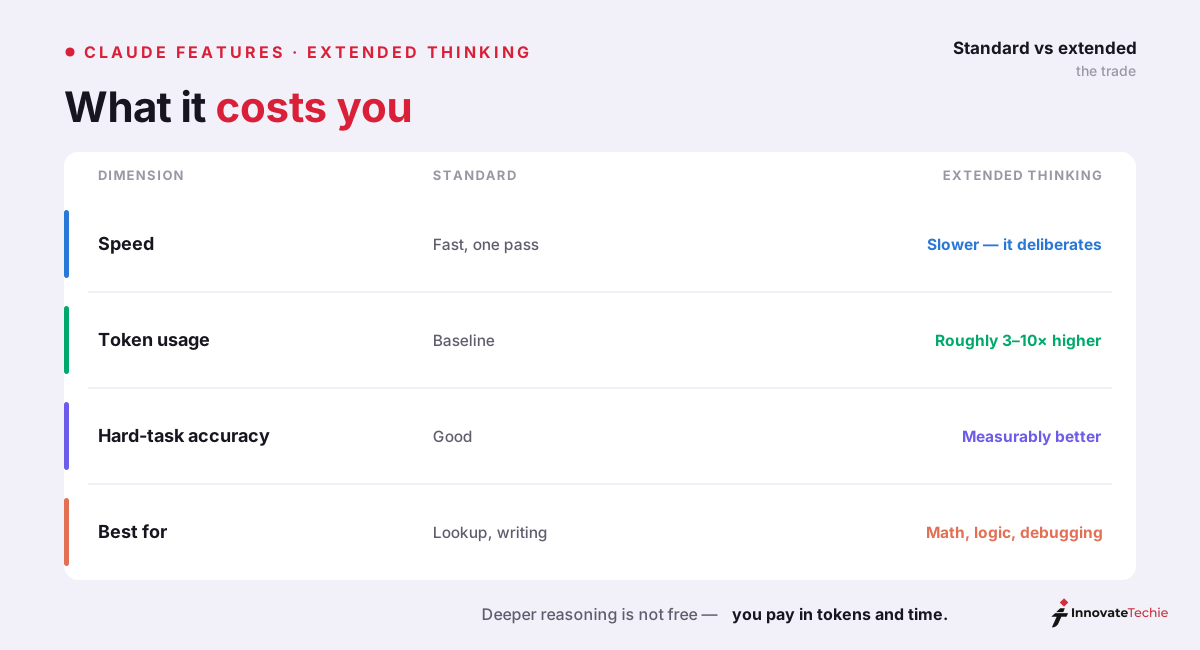
Claude extended thinking is not free, and the cost is larger than most people expect. Thinking tokens bill at the output-token rate. Because the model can generate thousands of reasoning tokens before it writes a single word of the answer, one extended-thinking call can burn 3–10x the tokens of a normal completion — and you pay for all of it, even though you only see a summary.
Latency scales the same way. A query that streams back in about five seconds normally can take 30 seconds or more with a large thinking budget, because the model is working through sequential steps before it starts writing. That pause is the feature doing its job, but it's a real user-experience cost in anything interactive.
| Dimension | Standard response | Extended thinking |
|---|---|---|
| Token usage | Baseline | Roughly 3–10x higher |
| Billing | Input + output tokens | Thinking tokens billed at output rate |
| Latency | ~5 seconds typical | 30+ seconds with a large budget |
| Best for | Lookups, writing, extraction | Math, logic, debugging, analysis |
Put those together and the economics are simple: on the right task, paying 5x for a correct answer instead of a plausible wrong one is a bargain. On the wrong task, you've paid 5x for the identical output. This is why we default to standard mode and reach for reasoning mode deliberately, task by task, rather than leaving it on globally.
Extended thinking vs normal mode
Choosing between the two comes down to whether the answer lives at the end of a reasoning chain or amounts to a retrieval. When you need Claude to think longer, you're buying self-correction; when you don't, you're buying nothing but a slower, costlier version of the same reply.
A practical workflow we use: draft with standard mode, then re-run only the hard cases with extended thinking. Classify a hundred support tickets in standard mode; escalate the three ambiguous ones to reasoning mode. Summarize a document normally; switch on thinking only when you need it to reconcile contradictory sources. This keeps the average cost near the standard rate while spending the premium exactly where it changes the outcome.
Claude extended thinking also composes well with good prompting rather than replacing it. Clear instructions, structured context, and worked examples still matter — the mode reasons better when the problem is stated cleanly. If you want the fuller picture of where reasoning mode fits among Claude's capabilities, our pillar on Claude AI features maps the whole surface, from thinking to tool use to memory.
Claude extended thinking has been a stable part of Anthropic's newer Claude models, and the behavior described here matches the current Claude.ai product and API.
The quick version:
- Turn it on for math, logic, debugging, and planning
- Skip it for lookups, summaries, and simple writing
- Thinking tokens are billed at the output rate
- Expect roughly 3–10× the tokens of a standard answer
Claude pricing at a glance
| Plan | Price |
|---|---|
| Free | $0 |
| Pro | $20 / month |
| Max | from $100 / month |
| API | Pay per token |
For the full breakdown of every plan, see our how much Claude costs guide.
Frequently Asked Questions

Written by
InnovateTechie
Writing about Claude and the Anthropic toolkit — models, Claude Code, pricing, features, and fixes, in clear, practical, hands-on guides tested by daily use.
View all posts →